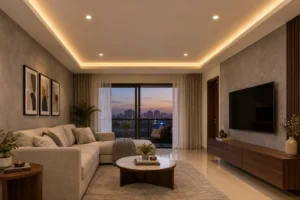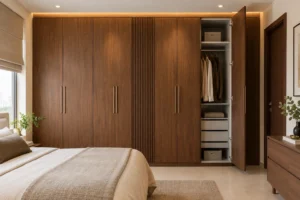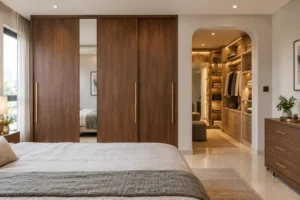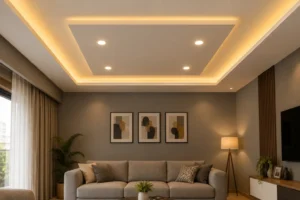
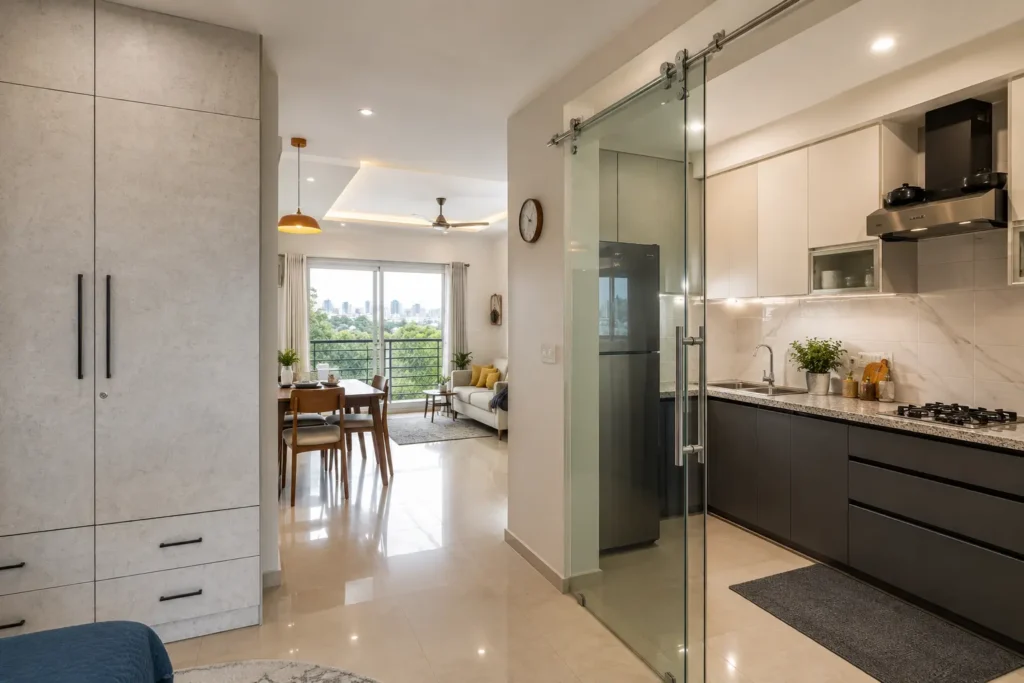
What is MDF? MDF, short for Medium Density Fibreboard, is an engineered wood panel made by pressing wood fibres, resin and wax together under heat and high pressure. No grain, no knots, dead flat surface. That flatness is exactly why it has quietly become the default core material for wardrobes, kitchen shutters and wall panels in almost every Bangalore home we’ve worked on this year.
It isn’t the only board you’ll get quoted for, though. Contractors will also throw around plywood, particle board and chip board like you already know the difference between them. Most people don’t, and we don’t blame them, nobody teaches this stuff. We sit with clients almost every week who signed a quote without really understanding what any of these terms meant, and a couple of them paid for that gap later, in swollen shutters and re-cut counters.
This is the guide we genuinely wish every client had read before their first site visit. Wood boards, stone, glass and metal, the four material families you’ll run into in nearly every quote, explained the way we’d explain it standing next to you at the site.
Why Does Material Choice Matter More Than the Design Itself?
We’ve run enough site visits across Bangalore to say this with a straight face: budget overruns rarely come from bad design. They come from the right-looking design sitting on the wrong material. A wardrobe render can look flawless on a laptop screen and still swell at the edges by its first monsoon.
A 2026 industry analysis by Mordor Intelligence found that residential interior spending in India is growing faster than commercial spending through 2031, with renovation work specifically outpacing new construction. Put plainly, more people than ever are making these calls for the first time, with nobody checking their homework before the carpenter shows up.
Wood Based Boards: MDF, Plywood, Particle Board and Chip Board
What Is MDF and Where Is It Used?
What is MDF actually made of? Wood fibres, not chips, not veneer strips, bonded with resin and wax, then compressed into one dense sheet. Zero grain means it takes paint and laminate cleanly, with no wood texture ghosting through underneath, which is the part carpenters love and homeowners rarely think to ask about.
MDF material uses in Indian homes usually come down to:
- Wardrobe shutters and internal shelving
- Kitchen cabinet fronts finished in laminate or PU
- TV units, false ceiling detailing and moulded skirting
- Decorative wall panelling and arches
Where it falls apart, sometimes literally, is standing water. MR grade, the moisture resistant version, shrugs off the odd kitchen splash. Standard MDF anywhere near a bathroom sink is a problem you just haven’t discovered yet.
For grade-by-grade detail and where each board actually belongs in your home, our MDF vs Plywood guide goes far deeper than this page has room for.

Talk to Us Before You Finalise a Single Board
If a contractor has already quoted you MDF, plywood or particle board and you’re not sure which one your project actually needs, don’t nod along and hope. Book a free material consultation with Blue Interiors and we’ll tell you straight what fits your rooms and your budget.
Plywood vs Particle Board vs Chip Board: Key Differences
This is where most of the confusion lives, so let’s pull the four apart properly.
| Material | Made From | Strength | Best For | Moisture Handling |
| Plywood | Thin wood veneer layers, cross glued | Highest | Load bearing units, kitchen base cabinets | Best with BWP grade |
| MDF | Compressed wood fibres | Medium to high | Shutters, panelling, paint finishes | Moderate, MR grade |
| Particle Board | Wood chips and resin, low pressure | Lower | Budget wardrobes, low load furniture | Poor |
| Chip Board | Coarse wood chips, compressed | Lowest | Flat pack furniture, temporary units | Weakest |
Particle board vs plywood really is just budget versus durability, no dressing it up. Particle board costs less on day one, then sags under sustained weight. We’ve personally pulled out more than one particle board shelf that bowed within two years under nothing heavier than a stack of blankets. Chip board interior uses stay mostly limited to low cost, low load furniture, where you’re already accepting a five to seven year lifespan going in.
The short version of mdf board vs particle board: MDF wins on density, screw holding and finish quality. Particle boards win only on price, and only for a little while.
Natural Stone: Granite, Marble, Quartz and Limestone
Stone is where Bangalore homeowners spend the most and, oddly, research the least. Before you fall for a slab pattern under showroom lighting, understand which category it actually sits in.
Granite is the workhorse. Heat resistant, scratch resistant, built for a kitchen counter that sees real daily use, not just Instagram photos. Quartz is engineered, more uniform looking, but it doesn’t love sitting right next to a hot pan. We’ve laid out a full side by side in our Granite vs Quartz comparison if a countertop decision is next on your list.
The Black and Marble Combination Trend
The black and marble combination is one of the most requested premium looks we execute at Blue Interiors right now, no contest. Black granite flooring borders against white or grey marble inlays, or a black marble effect kitchen island set against lighter cabinetry. It photographs beautifully, and clients almost always underestimate the upkeep. Marble needs sealing every 12 to 18 months in Bangalore’s dust and humidity, something we make a point of telling people before they sign off, not after. Our Natural Stone guide covers sealing schedules and where each finish actually holds up over time.
Kota Stone and Limestone for Indian Homes
Ask anyone who has actually lived with it for a kota limestone tiles review and you’ll hear the same three things, almost word for word. It stays cool underfoot through Bangalore’s warmer months, it’s naturally slip resistant when honed, and it costs a fraction of granite or marble per square foot. The trade off is a narrower colour range, mostly greens and greys, and it needs periodic polishing to keep its finish looking new.

Glass in Interior Design: Frosted, Lacquered and Toughened
Glass has moved well past bathroom windows. Frosted Glass gives privacy without building a solid wall, which is exactly why it shows up so often on pooja room doors and study partitions. Lacquered Glass brings colour and shine to kitchen backsplashes and wardrobe shutters, and honestly, it’s one of the easiest surfaces to wipe clean when a cooking session goes sideways.

Metal Surfaces: Stainless Steel in Modern Kitchens
Stainless Steel counters and shutters are gaining ground fast in Bangalore’s modern kitchens. Hygienic, heat proof, genuinely unbothered by the moisture problems that plague wood based boards. It’s not for every taste, it reads industrial rather than warm, and we tell clients that plainly. But for a kitchen that sees heavy daily cooking, it’s hard to argue against pure longevity.
Not Sure Which Material Fits Your Kitchen?
Every kitchen we’ve built in Bangalore deals with different water exposure, sunlight and daily wear. Speak to a Blue Interiors designer about your specific layout before committing to a material you can’t easily undo.
Sustainable Materials: Bamboo and Reclaimed Wood
A bamboo wall panel is one of the fastest growing requests we get from clients chasing an eco conscious accent wall without going fully rustic on us. Bamboo regrows in three to five years against decades for hardwood, and treated panels resist warping reasonably well indoors, though not indefinitely. Paired with wood wall panels interior applications, reclaimed teak strips or fluted MDF panelling, this category lets you add real texture to a room without committing to full carpentry.

How Do I Choose the Right Material for Each Room?
- Kitchen counters: granite or quartz, built for daily heat and knife contact
- Wardrobe shutters: MDF with laminate for a smooth painted look, plywood carcass underneath for actual load
- Bathroom vanity: MR grade MDF or granite only, never standard particle board, we’ve said this enough times to mean it
- Living room flooring: kota limestone or marble depending on budget and how much upkeep you’re honestly willing to do
- Vastu conscious homes: material colour and placement matter just as much as the material itself, our Vastu Colours for Home guide pairs well with this if you’re planning room by room
Material Cost Guide for Bangalore Homeowners (2026)
| Material | Approx. Price Range (per sq. ft) |
| Particle board | Rs 40 to Rs 70 |
| MDF, standard | Rs 65 to Rs 110 |
| Plywood, BWP grade | Rs 100 to Rs 180 |
| Granite | Rs 90 to Rs 250 |
| Engineered quartz | Rs 180 to Rs 400 |
| Kota limestone | Rs 45 to Rs 90 |
Prices are indicative and move with grade, brand and current raw material costs. Treat this as a starting point for conversation, not a fixed number, and always get a site specific quote before locking a budget.
How Blue Interiors Selects and Sources Materials
Real case, no names changed for effect, just the details toned down out of respect for the client: a homeowner in Whitefield came to us mid-project after her previous contractor had used standard MDF, not MR grade, in her utility area shutters. Within eight months, the board had swollen at the edges from the washing machine splash, the kind of warping you could see from across the room. We rebuilt the unit using MR grade MDF with edge sealed laminate. A ten thousand rupee fix that should have cost nothing if the right grade had been specified on day one.
Two things we tell every client before material selection even begins:
Ask which grade of board you’re being quoted. “MDF” on its own tells you nothing about moisture resistance, and a vague answer is a red flag worth pausing on.
Ask for slab photos before the stone is cut, not after. Natural stone variation means the sample chip in the showroom rarely matches the full slab that turns up at your site.
Every material that goes into a Blue Interiors project passes through our in house factory checks before it reaches you. No unsealed board, no unverified stone batch, no exceptions we’ve made so far.
FAQ: Interior Design Materials
What is MDF used for?
MDF is mainly used for wardrobe shutters, kitchen cabinet fronts, wall panelling and painted furniture where a smooth, grain free surface is needed.
Is MDF better than plywood?
Neither wins outright. Plywood is stronger and handles moisture better, which suits load bearing units. MDF gives a smoother, more paint ready finish for shutters and panelling.
Is MDF waterproof?
Standard MDF is not waterproof and swells with prolonged moisture exposure. MR grade MDF handles occasional splashes but still isn’t meant for direct water contact.
Which is better, MDF or particle board?
MDF is denser, holds screws better and gives a cleaner finish than particle board, which is why most designers keep particle board strictly for budget, low load furniture.
What is the difference between plywood and particle board?
Plywood is made from cross layered wood veneers and is significantly stronger and more moisture resistant than particle board, which is made from compressed wood chips and resin.
Get a Material Plan Built Around Your Home, Not a Generic Checklist
Reading about materials only takes you so far. The right choice depends on your rooms, your budget and Bangalore’s climate, not a blog post, however detailed. Book a free consultation with Blue Interiors and we’ll walk your space with you before a single board is ordered. Browse real completed homes in our Portfolio, or see how we run turnkey projects end to end on our Services page.