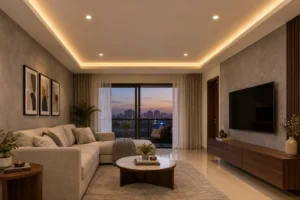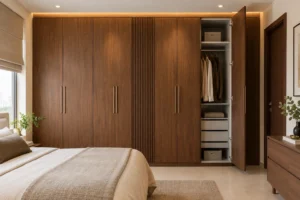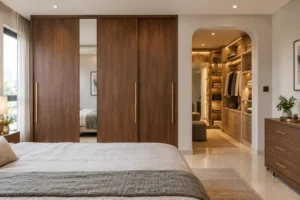
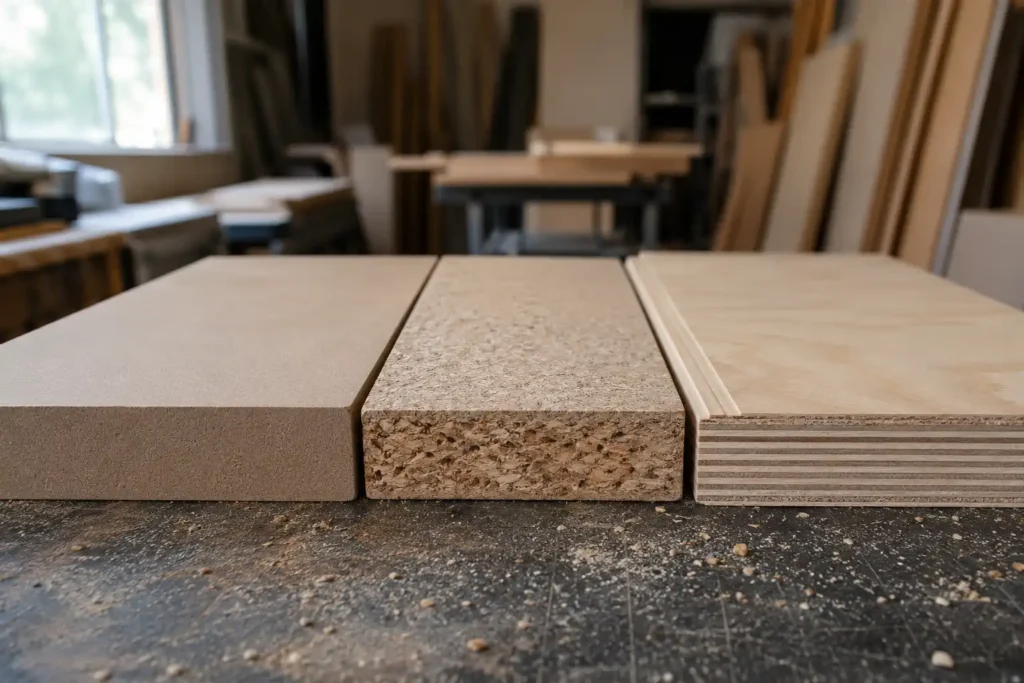
MDF board vs particle board: MDF is denser, smoother, and handles moisture better. Use it for wardrobe shutters and TV panels. Particle board swells, loses screw grip, and fails first. For kitchen and bathroom carcasses in Bangalore homes, BWP marine plywood is the only board worth specifying.
Why This Decision Matters More Than You Think
Your contractor told you the kitchen will use MDF board or particle board. You nodded and moved on to the laminate samples.
Stop there. Go back.
Nobody in this industry volunteers what goes inside your furniture. They show you the finish. The colour. The handle style. The things you can see and touch in the showroom. What the carcass is built from, the actual structural board holding your kitchen together, gets mentioned only if you ask. And most homeowners do not know to ask.
We have walked into Whitefield apartments three years after handover where the lower kitchen cabinets near the sink have swollen so badly the doors will not close. We have seen wardrobe bases in Hebbal flats that turned soft because the board absorbed two monsoons of humidity through an unsealed edge. In every single one of those cases, the contractor had used a cheaper board than what the homeowner was told, laminated over it, and the problem showed up only after the contractor was long gone.
This guide is written so that does not happen to you. Whether you are planning modular kitchen cabinets, a full bedroom wardrobe, or any structural furniture board application, the engineered wood your contractor picks determines how long your home actually holds up.

What Is MDF?
What exactly is MDF material and where does it work?
MDF is Medium Density Fibreboard. Wood fibres broken down fine, mixed with resin and wax, compressed under heat until you get a dense, completely grain-free panel. Run your hand over it and there is nothing. No grain lines, no knots, no variation. Just a flat, uniform surface.
That is its strength and its limitation, both at once.
The flat surface is why painters and fabricators love it. Laminate bonds to it cleanly. Paint sits without grain bleeding through. CNC routing for profile doors comes out sharp and consistent. For wardrobe shutter doors, TV unit facades, and decorative wall panels, MDF finishes better than plywood every time. That is a fact, not an opinion.
The limitation is cut edges. A raw MDF edge left exposed in Bangalore humidity is basically a compressed sponge waiting to meet water. It will swell. The laminate will bubble. The edge will crumble. The fix costs more than prevention.
Prevention is not complicated. Factory-applied two-millimetre PVC edge-banding on every cut edge before the furniture leaves the workshop. Two coats of primer sealing on any edge that will face moisture. Adds thirty minutes per cabinet in production. Many fabricators skip it because it slows throughput. When your wardrobe edges start peeling in year two, that is the thirty minutes they saved.
Expert Tip from Ar. Sunita Reddy, Interior Consultant, Bengaluru: “MDF is the right call for shutters on most projects. But it must leave the factory edge-banded, not site-banded. On-site banding is rushed, applied in poor conditions, and peels within a year. The board is not failing. The finishing process is.”

What Is Plywood and Which Grade Do You Need?
What is the difference between BWR and BWP plywood for Indian homes?
Plywood is thin wood veneers stacked with alternating grain directions and bonded under pressure. It is the most trusted interior wood panel material for structural home furniture in India, and the gap between it and the alternatives becomes very clear when you understand the grades. That alternating grain is the entire reason it outperforms every engineered wood alternative on structural strength. It does not snap. It does not sag. Screws near the edge hold because there is actual wood fibre running in multiple directions around them.
Three grades matter for Bangalore homes. Only three.
MR Grade is moisture resistant in name only. Fine for a bedroom wardrobe in a dry room. Not acceptable for kitchens or bathrooms under any circumstances, regardless of what your contractor says about sealing.
BWR Grade handles genuine humidity. Appropriate for most interior room applications including wardrobe carcasses where moisture exposure is moderate.
BWP Grade, also called boiling waterproof plywood or marine plywood, is the only board that belongs near a kitchen sink, under a bathroom vanity, or inside any space that will see water over time. If someone is quoting you plywood for kitchen carcasses and cannot name the grade, assume it is MR and ask again. It is tested for prolonged water exposure. It is not optional in wet areas. It is the specification.
The data point that ends most board debates: treated plywood swells 2 to 4 percent in moisture. MDF swells 5 to 8 percent. Particle board swells 10 to 15 percent and does not recover. According to Mordor Intelligence’s India Furniture Market Report 2025, wood maintains a 57.35 percent market share in India’s furniture sector, with the mix shifting toward engineered boards because of cost, consistency, and BIS regulatory compliance. That shift is happening precisely because homeowners are learning that not all engineered boards perform the same way under Indian conditions.

What Is Particle Board or Chip Board?
What is particle board and is it safe to use inside home furniture?
Particle board, also called chip board, is wood chips, sawdust, and shavings pressed together with urea-formaldehyde resin. It is the lowest grade of engineered wood available for furniture board applications and the most commonly misrepresented material in the Indian interior industry. It is the cheapest engineered wood you can buy. That cost advantage is the entire reason it ends up inside so much Indian furniture without homeowners ever knowing.
Under laminate it looks identical to everything else. That is not a coincidence.
Screws near edges pull loose over time. Shelves sag under sustained load. The moment moisture reaches it, through steam, a slow pipe drip, or just Bangalore’s monsoon humidity finding an unsealed edge, it swells. The laminate bubbles. The hinge face detaches. The cabinet door drops. None of this is reversible.
One detail almost no comparison article mentions: lower-grade particle board off-gasses formaldehyde into whatever room it sits in. In a sealed bedroom with wall-to-wall wardrobes, this is not a minor point. Ask specifically for E1 or E0 certified boards compliant with BIS emission norms. If your contractor looks blank when you say that, you now know something important about how they source their materials.
Where particle board is genuinely acceptable: wardrobe back panels, inner shelves of shoe racks, concealed dry partitions that carry nothing and see no moisture. That is the full list. It stops there.

Head-to-Head Comparison: 7 Factors That Actually Matter

Strength and load bearing: MDF density runs 700 to 850 kg per cubic metre. Particle board runs 590 to 700. That gap translates directly into how long hinges stay put and how much weight a shelf takes before bowing. Plywood leads both. A plywood shelf holds roughly twice the weight of MDF and four times that of particle board before visible deflection.
Moisture resistance: BWP plywood first, sealed MDF second, MR plywood third, particle board last and not close.
Screw holding: Plywood near edges, then MDF in the centre, then particle board which you should pre-drill and keep screws at least 20mm from the edge. Particle board hinge screws loosen over time. In the one location where you need them to stay fixed.
Surface finish: MDF. Not debatable.
Weight: MDF runs 25 to 30 percent heavier than particle board. For wall-mounted overhead cabinets, that weight goes directly onto your wall anchors.
Cost in Bangalore 2025, per sheet 8×4 ft:
| Board Type | Grade | Approximate Price |
| Particle Board | Standard | Rs. 700 to 1,200 |
| MDF | Standard | Rs. 1,200 to 1,800 |
| Plywood | MR Grade | Rs. 1,500 to 2,200 |
| Plywood | BWR Grade | Rs. 2,200 to 3,200 |
| Plywood | BWP Marine | Rs. 3,500 to 5,500 |
Ask for invoices from the supplier with the brand name and grade printed. Not estimates. Not verbal confirmations. Actual paperwork.
VOC emissions: BIS Quality Control Orders now cover minimum emission standards for all three board types. For sealed bedrooms and closed wardrobes, ask for E1 or E0 rated material. Low-grade particle board is the worst offender in this category by a significant margin.
Is your contractor’s material specification actually in writing?
Blue Interiors documents every board grade, brand, and BIS certification on your project brief before fabrication begins. No verbal assurances. No surprises after handover.
Book a Free Consultation with Blue Interiors
Which Board for Which Room?

Kitchen cabinets: BWP plywood for the carcass. When homeowners search for the best plywood for kitchen use in Bangalore, the answer is always boiling waterproof plywood from a certified brand. Every day in a Bangalore kitchen brings steam, oil vapour, and water near the sink. No other board handles this reliably over ten years. MDF with factory PVC edge-banding for the shutter doors. That combination is what Blue Interiors specifies on every kitchen project.
Bedroom wardrobes: MR grade plywood or BWR plywood for the body structure depending on room humidity. MDF for wardrobe shutter faces with factory-applied PVC banding gives you the best combination of structural strength and surface finish. Choosing the right wardrobe material at this stage costs nothing extra if it is specified upfront. Do not accept site-applied banding on MDF shutter edges.
Living room TV unit: MDF works for decorative facades in a dry, air-conditioned room. Any section that carries actual equipment load needs a plywood carcass underneath.
Bathrooms: No particle board anywhere. Not the vanity, not the under-sink cabinet, not the back panel. One pipe seepage ends it. Blue Interiors uses BWP marine plywood with PU-sealed edges for every bathroom installation. No budget conversation changes that.
Wardrobe shutters made from engineered boards can be enhanced with our lacquered glass wardrobe shutters for a sleek, modern finish
A Real Bangalore Homeowner Case Study
What actually happens when particle board is used in a kitchen?
Priya and Ramesh finished their 3BHK renovation in Whitefield in 2022. Their contractor told them the kitchen used good quality material. Two years later, the lower cabinets near the sink swelled visibly. Laminate peeled at the bottom edges. Hinge screws pulled out of the cabinet sides.
A carpenter opened the base panel. Particle board underneath, throughout the lower kitchen carcasses, laminated and painted to look identical to plywood. The contractor had switched material to improve margins. Total replacement cost: Rs. 1.4 lakhs.
At Blue Interiors, close to 40 percent of clients who come to us for renovation work are coming from exactly this situation. A prior project where inferior board was used without disclosure, and the homeowner only discovered it when something started failing. The cost of correcting it always exceeds what proper specification would have added at the start.
What Blue Interiors Uses and Why We Are Telling You
Most interior firms do not tell you what goes inside your furniture. They move the conversation to laminates and hardware finishes where the margins are and where you cannot ask uncomfortable questions.
Blue Interiors puts this in writing on every project brief before fabrication begins:
- BWP Marine Plywood, Century or Greenply certified, for all kitchen and bathroom carcasses
- MDF with factory-applied PVC edge-banding for wardrobe shutters and decorative panelling
- Hafele hardware for hinges, channels, and fittings, matched to board specification
- BIS certification stamps on all boards, shown to the client before any cutting starts
We do this because we have spent fifteen years fixing other people’s shortcuts and we are tired of watching homeowners pay twice for the same furniture.
If your current contractor cannot document the same information in writing before work starts, that is the most important thing you learned today.
If durability and moisture resistance are priorities, compare stainless steel kitchen cabinets before deciding on the best base material.
Questions to Ask Your Contractor Right Now
Write these down before your next site visit.
- What board is going into the kitchen carcass and what grade of plywood is it specifically?
- Can you show me the BIS stamp on the sheet before cutting starts?
- What brand of MDF or plywood are you specifying and can I see the invoice?
- Is the MDF edge-banded at the factory or will it be done on-site?
- Can I get the full material specification in writing before any fabrication begins?
- What happens to the warranty if boards swell or laminate delaminates after handover?
A contractor who knows their material has no reason to struggle with any of these questions.

FAQ
Which is better, MDF board or particle board for home furniture?
MDF, in most real-use situations. Denser, better screw retention, cleaner surface finish, far better moisture performance. Particle board earns a place only in dry, non-structural, zero-load locations like a wardrobe back panel. For furniture you actually use every day, MDF is the minimum. BWP plywood is the right answer for structural and wet-area applications.
Is particle board good for modular kitchen cabinets in India?
No. Steam, oil vapour, and water are present in Indian kitchens every single day. Particle board swells permanently under that exposure and typically fails within two to four years in Bangalore homes. Specify BWR or BWP plywood for kitchen carcasses. Get it in writing before fabrication starts.
What is the difference between MDF and particle board in terms of durability?
MDF holds up for 12 to 18 years in maintained indoor conditions. Particle board lasts 8 to 12 years in genuinely dry areas and much less near any moisture. The density gap between 700 to 850 versus 590 to 700 kg per cubic metre explains most of that difference. For furniture built to last, MDF is the floor, not the ceiling. BWP plywood is the ceiling.
Can MDF be used in bathrooms?
Standard MDF should not go in a bathroom. Moisture-resistant MDF variants still perform poorly with sustained water exposure. BWP marine plywood with PU-sealed edges is what belongs in a bathroom vanity or under-sink cabinet. Blue Interiors does not use MDF in bathrooms regardless of how the budget conversation goes.
How do I know what board my contractor is actually using?
Ask to see the sheets before cutting. Look for the BIS stamp, IS:1328 for plywood, IS:12406 for MDF, printed on each sheet. Get the brand name and grade on your work order in writing. Take a cut piece home and soak it in water for 24 hours. What you see after that is more honest than anything said in a showroom.
Conclusion
The furniture that survives ten Bangalore monsoons is not built on a good laminate choice. It is built on the right core board, specified correctly, documented before the first cut, and installed by a team that does not hide what goes inside your home.
MDF board vs particle board is a decision with real consequences. MDF wins most everyday comparisons. BWP marine plywood wins where the consequences of getting it wrong are highest: your kitchen, your bathroom, and every structural piece that carries load year after year.
At Blue Interiors, this is a written commitment on every project brief, not a marketing line. We show clients the boards before cutting begins. We put the grade and brand on the work order. We do it because this industry has spent too long getting away with not doing it.
If you’re wondering what is MDF, it’s an engineered wood product made from wood fibers bonded with resin under high pressure.
Get a Material Specification in Writing Before Work Begins
Most Bangalore homeowners discover what went inside their furniture only when something fails. By then the repair cost is higher than a correct specification would ever have been.
Blue Interiors documents every board grade, brand name, and BIS certification on your project brief before fabrication starts. You see the boards. You see the stamps. You sign off before a single cut is made.
Book Your Free Consultation with Blue Interiors
Author Bio
Written by the Blue Interiors Design Team, Bangalore. Fifteen plus years executing interiors across more than 1,000 Bangalore homes from Whitefield to Hebbal to Electronic City. This team has opened enough failed cabinets to know exactly how contractors cut corners on board specification and this guide exists so homeowners stop finding out the hard way. Reviewed for technical accuracy by the Blue Interiors in-house fabrication unit, certified Hafele design partner, Bangalore.