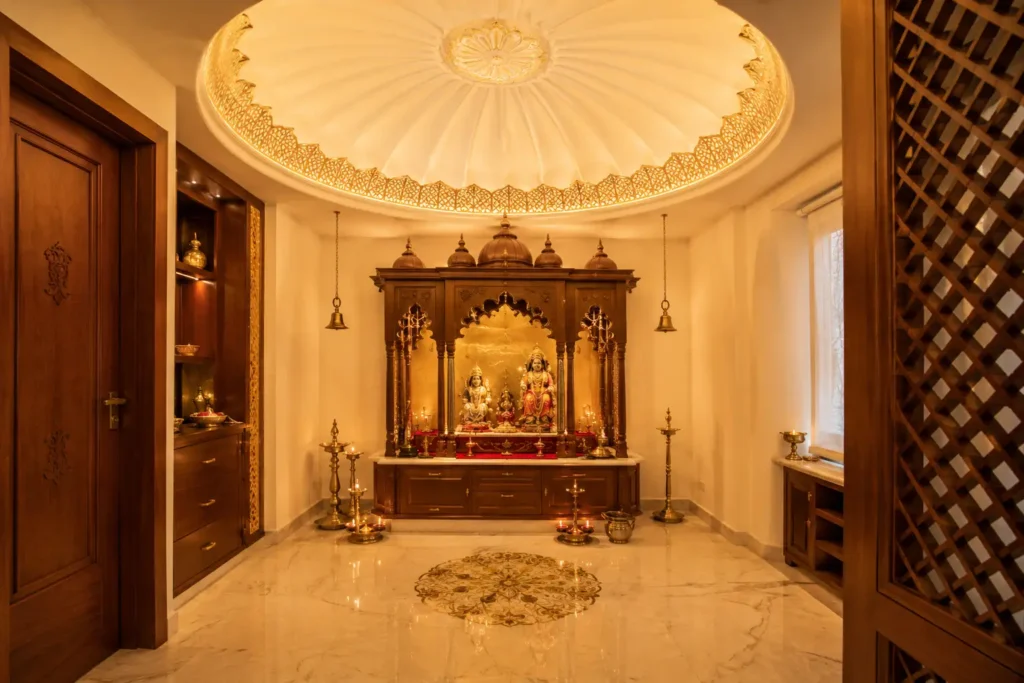
A pooja room ceiling design works best as a deliberate feature above the mandir, not an afterthought. In Bangalore homes, the most popular choices are a POP dome for higher ceilings (9 ft+), a cove-lit tray for open-plan spaces, or a flat POP border for standard 10-foot slabs. Costs run ₹45 to ₹180 per square foot depending on complexity, and Vastu requires the section directly above the idol to stay flat and beam-free.
Key Takeaways:
- A pooja room ceiling design should frame the idol without competing with the mandir’s own carving.
- POP domes need at least 9 feet of ceiling height; shallow borders or coves work for standard 10-foot slabs.
- Vastu requires a flat, unbroken ceiling directly above the idol, with no beam, duct, or bathroom above that section.
- POP costs ₹45 to ₹180 per sq. ft. in Bangalore; wood panelling runs higher at ₹150 to ₹350 per sq. ft.
- Keep incense smoke and diya flame away from the ceiling surface to protect the finish long-term.
Pooja room ceiling design is the one decision homeowners keep pushing to the very end, right after the mandir is already ordered and the electrician is asking where the wiring should go. That’s backwards, honestly. The ceiling is what your eyes catch first when you walk into the space, before you even register the idol.
Here’s what usually happens instead. Someone spends three weekends comparing mandir catalogues, picks the perfect teak unit, and then the room gets finished with a plain white slab overhead and a single bulb. It looks unfinished. Not because the mandir is wrong, but because nothing above it is doing any work.
That’s what this guide fixes. Seven real ceiling ideas, what they actually cost in Bangalore right now, the Vastu rules people genuinely get wrong, and the maintenance stuff nobody tells you about until the finish starts looking tired two years in. Manish Jain, who’s been running Blue Interiors as Founder and Creative Director for over fifteen years, walked me through the calls he makes on slab height and beam placement that don’t usually show up in a photo gallery.
Why the Ceiling Gets Ignored (And Shouldn’t)
The job of the ceiling above a mandir is simple. Frame the idol, don’t compete with it. Too plain and the corner reads like a storage nook that happens to have a shrine in it. Too busy and it starts fighting the carving on the mandir itself, which is a shame after someone spent real money on that carving.
Three things decide what you can actually do here: your slab height, whether a beam already runs through that corner, and how much daylight the space gets. Check those before you fall in love with any specific design, because half of Pinterest simply won’t fit a standard 10-foot Bangalore apartment slab.
There was a project in HSR Layout last year where the client had exactly that problem, a flat 10-foot slab, no room for a real drop. We went with a shallow 3-inch POP border and warm cove lighting instead. It solved the height issue and still gave the corner some presence. Nobody photographs that kind of pooja room ceiling design for a mood board, but it’s the one that actually works for most flats in this city.
Idea 1: The Classic POP Dome
The dome is still what most people ask for first, and it makes sense. It’s the closest thing to a temple ceiling you can build inside an apartment, and it does the job of pulling your eye upward before you’ve even consciously looked at the idol.
Structurally, it’s a curved POP shell built over a metal frame, rising from the ceiling edge to a point somewhere near the centre, usually lit from inside. Save it for rooms with nine feet of height or more. Anything tighter and the dome starts feeling like it’s sitting on your shoulders instead of floating above the mandir.
POP takes gold and pastel paint beautifully, and it’s fire-resistant, which matters given how close diyas and incense sit to it. If you want to check what your contractor’s POP is actually rated for, the Bureau of Indian Standards testing specifications for gypsum plaster under IS 2542 cover setting time and strength. Most vendors won’t bring this up unless you ask.

Not sure your ceiling can take a dome? Book a free consultation and we’ll measure it properly before you commit to anything.
Idea 2: Cove-Lit Tray Ceiling
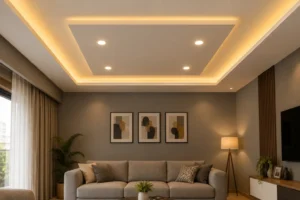
If a dome feels a bit much for your space or your taste, a cove-lit tray gets you most of the same lift with a cleaner, more contemporary line.
It’s built as a recessed ledge around the ceiling edge that hides an LED strip, so the light bounces up and out instead of straight down. This suits open-plan flats especially well, where the pooja unit sits inside the living room rather than behind its own door, which is more common now than it used to be.
It pairs naturally with what we’ve written about in our guide to modern pooja room designs for homes without a spare room. When there’s no wall separating the shrine from the living area, the ceiling has to do that job instead.

Idea 3: Carved Wood Panel Ceiling
Wood does something POP just can’t. It brings warmth, and it’s the obvious pick if you’re going for a Kerala-style or South Indian traditional pooja room.
This one uses veneer, laminate or solid wood shaped into a shallow dome or a tiered pattern, sometimes echoing a gopuram, the stepped temple tower you’ll recognise from South Indian temples. It works best when the mandir unit is already in teak or Sheesham, so the ceiling and the shrine feel like one continuous piece of design rather than two things bolted together.
We’ve covered the full range of gopuram-style options in our piece on South Indian traditional pooja room designs, including carving depth and which wood grades hold up.
Idea 4: Layered Multi-Tier POP with a Chandelier
For bigger pooja rooms where height genuinely isn’t a constraint, a multi-tier POP ceiling with a chandelier in the centre is about as formal as this gets.
Picture two or three POP tiers stepping down toward the middle, with a brass or crystal chandelier hanging from the lowest point. The stepping creates real depth even under ordinary lighting, and the chandelier becomes the thing you notice, not a competitor to the mandir’s own carving.
This is where restraint actually matters more than people expect. Manish put it this way when we talked about it: “Clients often want the ceiling to match the mandir tier for tier, same level of carving, same intensity. I usually talk them out of it. A slightly simpler ceiling makes an ornate mandir look more expensive, because your eye gets somewhere to rest before it reaches the detail.”

Idea 5: CNC Jaali POP Ceiling
Jaali, the perforated lattice you see in a lot of traditional Indian buildings, works surprisingly well cut into POP rather than only wood or stone.
Machine-cut lattice panels get set into the ceiling and backlit, so the pattern throws shadows onto the wall behind the idol. This is a strong pick if your pooja room door already has jaali detailing, since the two elements start talking to each other instead of looking like separate decisions made at different points in the project.
If you’re comparing jaali against other door options for the same room, our breakdown of nine pooja room door design styles covers where jaali sits on cost against solid wood.

Want to see how jaali shadow patterns actually look in a finished room? Talk to our team and we’ll show you references from real projects.
Idea 6: Mirror and Glass Accent Ceiling
This one’s uncommon, but it earns its place in a small or genuinely dark pooja corner with no window.
A mirror or frosted glass panel sits inside a POP or gypsum frame and bounces light from a spotlight, or even just the diya flame, back into the room. It’s not for every home. But it solves something the bigger guides tend to skip entirely: what do you actually do when your pooja corner barely sees daylight for most of the day.

Idea 7: Minimalist Flat POP Border with Backlight
If you want the lift without touching your ceiling height at all, this is the lowest-commitment option on the list.
It’s a shallow, flat POP strip running around the ceiling edge above the mandir, usually 3 to 6 inches wide, with a thin LED tucked underneath. It works with any ceiling height, which is exactly why it fits most standard 10-foot Bangalore slabs without any real drop.
This is the same fix we used in the HSR Layout project I mentioned earlier, and honestly, it’s the option we get asked for the most. Homeowners want the effect. They don’t always want the cost or the headroom loss that comes with a full dome.
Vastu Rules for the Ceiling Above the Idol
Vastu takes the space above the idol just as seriously as where you place the mandir on the floor. A dome or beam in the wrong spot is one of those avoidable mistakes people make without realising it until someone points it out.
The core rule is simple enough: keep the section directly above the idol flat and unbroken. No exposed beam, no duct, and definitely no bathroom on the floor above that spot. If a beam already crosses the corner and you can’t move it, don’t try to disguise it with an elaborate design. A cove that visually lowers the ceiling on both sides of the beam looks deliberate instead of like a workaround.
For the fuller set of direction and placement rules, our guide on Pooja Room Vastu Shastra covers idol-facing direction alongside these ceiling considerations.
What Pooja Room POP Design Actually Costs in 2026
Budget the ceiling as its own line item. This is the surprise that catches people off guard most often, halfway through a project, when the mandir quote didn’t include the ceiling at all.
In Bangalore right now, POP work for a pooja room ceiling design runs roughly ₹45 to ₹180 per square foot. Flat borders and simple coves sit near the bottom. Carved domes with layered lighting sit at the top. Most homeowners end up paying somewhere between ₹8,000 and ₹25,000 for a compact pooja corner ceiling, separate from whatever the mandir unit itself costs.
The 2019 India Houzz & Home Renovation Trends Study found that Indian homeowners typically renovate around three rooms per project, and ceiling work rarely gets its own budget line until someone’s already deep into the renovation. Price it upfront and skip that headache entirely.
POP vs Gypsum vs Wood
| Material | Best for | Maintenance | Approx. cost per sq. ft. |
| POP | Domes, jaali, carved detail | Wipe with a dry cloth, keep away from direct steam | ₹45 to ₹180 |
| Gypsum board | Clean geometric trays, coves | Low maintenance, resists minor cracking | ₹55 to ₹120 |
| Wood panel | Kerala-style domes, gopuram tiers | Needs periodic polish, smoke can dull the finish over time | ₹150 to ₹350 |
Photos on a page can only tell you so much about how any of this actually looks once the lighting’s switched on. Our portfolio of completed pooja room projects has several of these styles built out in real Bangalore homes, including the HSR Layout project referenced above.
File name: pop-vs-gypsum-vs-wood-pooja-ceiling-comparison.webp Alt text: Material comparison of POP, gypsum, and wood swatches for pooja room ceiling
Frequently Asked Questions
Is a POP ceiling safe to install directly above the diya and incense area?
Yes, POP is fire-resistant and handles the heat from diyas and incense without damage over normal daily use. It’s one of the reasons POP remains the standard choice for pooja room ceilings across Bangalore homes. Just avoid placing an open flame directly touching the surface.
Can a pooja room ceiling design be added later if the false ceiling wasn’t planned during construction?
Yes, a POP border, cove, or even a small dome can be retrofitted onto an existing flat ceiling without major structural work. It typically takes slightly longer than a first-time install since the contractor has to work around existing wiring and paint. Most homeowners do this during a renovation rather than new construction.
Does the pooja room ceiling design need to match the flooring material below it?
No, matching isn’t required, though many homeowners prefer a visual link, such as a gold-toned POP ceiling above marble flooring. The mandir unit itself usually sets the tone, and the ceiling should complement it rather than mirror the floor exactly. Contrast can work just as well as matching.
How do I know if my contractor is using good quality POP for the ceiling?
Ask for the brand name and check that it’s tested to BIS standards under IS 2542, which covers setting time and strength. Good POP shouldn’t crack within the first year under normal humidity. If a contractor can’t answer basic questions about the material, that’s worth a second opinion.
Will a pooja room ceiling design increase my overall interior design cost significantly?
Not significantly for simple borders or coves, which add roughly ₹8,000 to ₹15,000 to a typical project. Carved domes or multi-tier designs with chandeliers push that higher, closer to ₹20,000 to ₹25,000. It’s a small fraction of a full pooja room budget but worth pricing in early rather than as an afterthought.
Ready to Design Yours?
A pooja room ceiling design is one of the smallest decisions in the whole room, and one of the ones that quietly decides whether the corner feels like an actual shrine or just a mandir pushed against a plain wall. Of the seven ideas above, the right one for you comes down to your slab height, your budget, and how detailed your mandir unit already is. None of that needs guesswork.
Book a free Ceiling Design Consultation with Blue Interiors and we’ll walk your space, check your slab height, and recommend a POP style with a real cost estimate attached, not a rough guess. Get started here.
About the Author
Manish Jain is the Founder and Creative Director of Blue Interiors, with over fifteen years of experience designing luxury residential and commercial interiors across Bangalore. He leads the firm’s in-house pooja room and false ceiling design work, backed by a 10-year production warranty. See more of Manish’s work in the Blue Interiors portfolio.