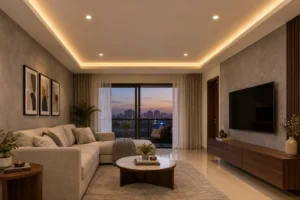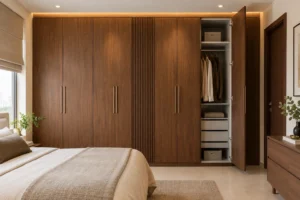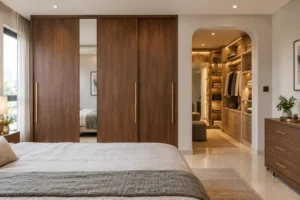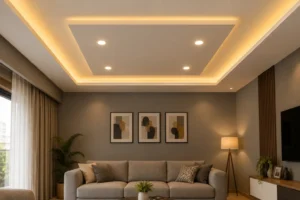
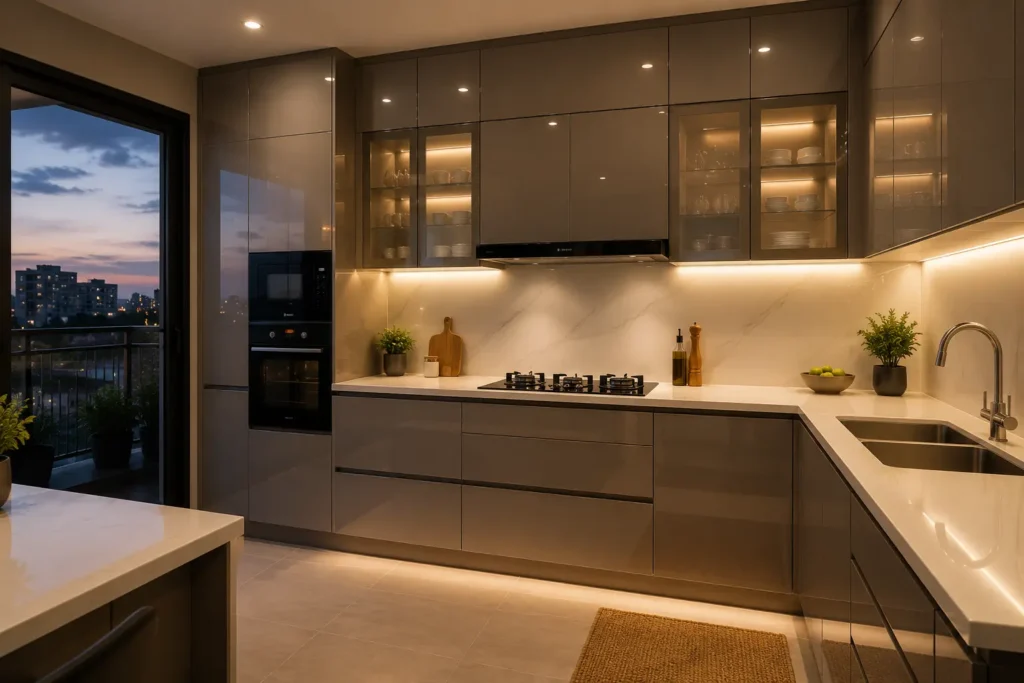
Lacquered glass is clear float glass with a colour-lacquer coating baked onto its reverse side. That makes it opaque, colourful, moisture-proof, and scratch-resistant. The grey lacquered glass texture is the most-specified shade in Bangalore homes this year. It works on wardrobe shutters, kitchen cabinet fronts, bathroom vanity panels, and feature walls. Standard options cost Rs.150 to Rs.300 per sq ft. Saint-Gobain variants run higher. It is not frosted glass. Frosted glass handles privacy. Lacquered glass handles colour, shine, and reflectivity. If someone is quoting you both under the same name, that is the first red flag.
Not sure if lacquered glass is the right finish for your space? Talk to our design team before you decide.
Get a Free Consultation at Blue Interiors
What Is Lacquered Glass and How Is It Made
What exactly is lacquered glass?
Clear float glass. Factory-applied colour lacquer on one side. Baked at high temperature until the lacquer bonds permanently into the glass surface. The glossy face points outward into the room. The lacquered face sits against the substrate, whether that is a wall, a cabinet carcass, or an aluminium frame.
That baking step is where the quality gap opens up. Proper lacquered glass is fundamentally different from back-painted glass, which is what a lot of contractors in Bangalore are actually supplying when they quote you something cheaper. Back-painted glass is painted on-site or in a workshop with ordinary paint. No baking. No bonding. It looks identical on Day 1. By Month 18 it is peeling at the edges, bubbling behind the shutters, and turning a shade of yellow that no amount of cleaning fixes.
We have seen this pattern at Blue Interiors across dozens of handovers from other contractors. A client saves Rs.60 per sq ft. Eighteen months later they are paying for full panel replacement plus the labour to redo the frames. The saving evaporates and then some.
Properly manufactured lacquered glass, such as Saint-Gobain’s SGG Planilaque or their SGG Colormaxx range, is humidity-resistant, scratch-proof, and produces low volatile organic compounds. In a home where a family lives and cooks daily, that last point is worth caring about.

Lacquered Glass vs Regular Glass vs Frosted Glass
What is the difference between lacquered glass, regular glass, and frosted glass?
| Feature | Lacquered Glass | Regular Glass | Frosted Glass |
| Appearance | Opaque, coloured, glossy | Transparent | Translucent, diffused |
| Primary use | Colour, shine, cabinets, walls | Windows, partitions | Privacy screens |
| Moisture resistance | High | Low | Moderate |
| Main advantage | Reflective, vibrant, easy-clean | Economical | Privacy without blocking light |
| Cost range Bangalore | Rs.150 to Rs.300 per sq ft | Rs.80 to Rs.120 per sq ft | Rs.120 to Rs.200 per sq ft |
If your contractor is quoting frosted glass for your wardrobe shutters and calling it an upgrade on lacquered glass, walk away from that quote. Frosted glass belongs in bathrooms and study partitions. Lacquered glass belongs where you want colour, reflectivity, and a surface that makes a room feel bigger without touching a wall.

Most Popular Lacquered Glass Colours for Indian Homes
Which lacquered glass colour works best for Indian homes?
Grey Lacquered Glass Texture: When and Where to Use It
Grey works everywhere and still manages to look deliberate rather than default. The grey lacquered glass texture sits well against white walls, warm wood cabinetry, concrete-effect laminates, and terracotta accents. It does not fight with anything in the room. It just makes the room feel more resolved.
At Blue Interiors, grey is our most-specified lacquered glass shade on wardrobe shutters. Clients who ask for a hotel-suite bedroom finish without going dark land here consistently. Light grey on sliding shutters reflects enough light to open up a compact room. Mid-grey on lower kitchen shutters paired with white upper shutters is currently our most-requested kitchen combination, and it has been for the past two years.
Use grey lacquered glass for wardrobe shutters, lower kitchen cabinet shutters, TV unit panels, and bathroom vanity shutters.
Expert Tip: Room faces west and gets strong afternoon sun? Go warm-grey with slight beige undertones, not cool blue-grey. Cool grey in warm afternoon light looks muddy by 4pm. We learned this on a Sarjapur Road project and had to swap panels before handover. That conversation with the client was not one we wanted to have twice.

Black Lacquered Glass Texture: Bold, Dramatic Applications
Black lacquered glass texture is for clients who have made a decision and are not hedging. We used it as a full kitchen backsplash in a Whitefield home. Under pendant lights at night, the kitchen looked like it had been designed for a shoot. The client sent photos to ten people before the contractor had even packed up.
The part nobody tells you upfront: black lacquered glass shows every fingerprint, every splash, and every smear. In an active Indian kitchen with pressure cooker steam and daily dal tadka, it shows them within hours. Dark charcoal is a more practical choice than true black if the kitchen sees serious cooking. True black works if your kitchen is more showpiece than workhorse.
Use black lacquered glass for kitchen feature backsplashes, TV unit backdrops, single bathroom accent walls, and wardrobe panels where the drama is fully intentional.

White and Cream: The Classic Safe Choice
White lacquered glass on kitchen shutters has been popular for eight years and still looks right. It reads clean, makes tight spaces feel larger, and is the correct call for anyone who wants modern and bright without spending three hours at a sample library. Cream adds just enough warmth to keep the space from feeling like a lab.

Still deciding on colour for your kitchen or wardrobe shutters? Our designers have specified lacquered glass across 5,000 plus Bangalore homes and can tell you exactly which shade works for your room’s light and layout.
Book a Free Design Consultation at Blue Interiors
Best Applications for Lacquered Glass in the Home
Where should lacquered glass be used in a home?
Wardrobe Shutters and Cabinet Fronts
The highest-return application in a Bangalore apartment budget. A sliding wardrobe with grey lacquered glass texture shutters in anodised aluminium frames costs a fraction of a full bedroom redesign and delivers a finish that reads as premium across the room. One wipe cleans it. It reflects light from the window. It does not dent, warp, or peel.
At Blue Interiors, we specify 4mm lacquered glass in anodised aluminium channels with a G-profile handle at all times. No drilling into the glass face. This specification holds through years of daily use without frame loosening or glass chipping at fixing points. Contractors who drill handles directly into lacquered glass are creating a failure point and a warranty conversation that will happen on your timeline, not theirs.

Kitchen Cabinet Doors and Backsplash Panels
Indian kitchens are brutal on surfaces. Masala spatters, pressure cooker steam, oil mist, and daily scrubbing are not occasional events. They are every morning. Lacquered glass shutters handle this without complaint. Wipe and done. No swelling, no warping, no laminate edges lifting the way MDF-based finishes do when humidity cycles through a kitchen that cooks seriously. Our guide on MDF vs Plywood explains why what sits underneath the finish matters as much as the finish itself.
For backsplash panels near the hob, always specify toughened lacquered glass. Section 8 explains exactly what happens when you do not.

Bathroom Vanity Panels
Underspecified in most Indian homes and should not be. Bathrooms have constant moisture. Lacquered glass handles moisture better than painted wood, MDF veneer, or HPL laminates on a vanity cabinet. Grey or white lacquered glass shutters with a vessel sink and a backlit mirror create a finish that looks significantly more expensive than the material cost.

Feature Wall Panels
A grey lacquered glass texture panel behind a sofa or a bed headboard creates depth and moves light around the room in a way flat paint cannot. It also outlasts wood wall panels and bamboo wall panels in rooms with humidity variation because glass does not swell, crack, or need refinishing after three monsoon seasons.

Combining Lacquered Glass with Other Materials
What materials pair well with lacquered glass?
Lacquered glass on its own across an entire surface reads cold and one-note. It needs something else in the composition to breathe.
- Grey lacquered glass with walnut veneer or wood laminates: Wood warmth breaks the gloss and the room stops feeling like a showroom
- Black lacquered glass with brushed brass hardware: High drama, fully intentional, works when the rest of the room supports it
- White lacquered glass with concrete-effect laminates: Clean and minimal, the combination that photographs best in tight kitchens
- Grey lacquered glass with bamboo wall panels: Natural texture against a reflective surface, particularly strong in bedrooms with low ambient light
The one pairing worth avoiding outright: lacquered glass adjacent to a mirror. Two competing reflective surfaces in the same sightline create visual noise that no styling trick resolves.

Cost of Lacquered Glass in Bangalore: 2026 Price Guide
How much does lacquered glass cost in Bangalore?
As of June 2026, lacquered glass in Bengaluru is priced at approximately Rs.300 per sq ft for standard options. Saint-Gobain’s range sits around Rs.190 per sq ft at distributor pricing in Bengaluru, with installed project costs moving higher once aluminium channels, hardware, and labour are added.
| Category | Material Cost per Sq Ft | Installed Approximate |
| Basic lacquered glass | Rs.80 to Rs.150 | Rs.250 to Rs.400 |
| Mid-range branded | Rs.150 to Rs.300 | Rs.400 to Rs.700 |
| Saint-Gobain SGG Planilaque | Rs.190 to Rs.250 | Rs.500 to Rs.800 |
| Toughened lacquered glass | Rs.350 to Rs.500 | Rs.700 to Rs.1,200 |
According to IMARC Group’s India Modular Kitchen Market Report, acrylic, polyurethane, and lacquered glass shutters are gaining significant share over basic laminates in metro premium projects as buyers increasingly favour scratch-resistant, glossy, easy-to-clean finishes that hold up to long-term Indian cooking conditions.
For a material budget specific to your kitchen or wardrobe project, visit Blue Interiors’ interior design services.

Working out a material budget for your kitchen or wardrobe? We will give you a real number based on your actual brief, not a ballpark pulled from a catalogue.
Talk to the Blue Interiors Team
Maintenance Dos and Don’ts
How do you clean and maintain lacquered glass?
Do:
- Wipe daily with a damp microfibre cloth
- Use diluted vinegar-water spray for oil residue and fingerprints
- Clean spills promptly, not because the glass surface stains but because grease sitting at the silicone edge seal degrades the seal over months
- Seal all edges with neutral-cure silicone to prevent moisture sitting behind the panel
Do not:
- Use abrasive scrubbers or steel wool, one pass scratches the surface and those scratches do not buff out
- Use ammonia-based glass cleaners, they break down the lacquer coating from the surface progressively
- Direct a steam cleaner at the lacquered face
This is the maintenance argument that actually justifies the material cost. Veneer needs periodic oiling and touching up. Painted MDF chips and needs repainting. Lacquered glass needs a cloth.
The Number One Installation Mistake to Avoid: Bubbling Near Heat
Why does lacquered glass bubble and how do you prevent it?
Sustained heat and steam exposure causes the lacquer to separate from the glass substrate. The panel looks completely fine for six to nine months. Then small bubbles appear near the hob area. They spread. Within a year the shutter panel needs full replacement, not repair.
At Blue Interiors, we have documented this exact failure on projects handed over by other contractors who used standard lacquered glass as a direct hob backsplash with no clearance or toughening specification. The client thought they were getting lacquered glass. They were. The problem was not the material. It was where it was placed and how it was specified.
Correct specification at this stage costs almost nothing extra in the design decision. It costs significantly more to fix after installation.
- Specify toughened, tempered lacquered glass for any surface within 600mm of a heat source
- Build a minimum 60mm clearance between the hob edge and the lacquered glass panel into the design drawings, not as an afterthought on site
- Use neutral-cure silicone only at all edges, acid-cure silicone attacks the lacquer coating from behind and the damage is invisible until it is too late
- During installation, apply adhesive pressure evenly across the full panel surface to eliminate air pockets, which become bubbles under heat
Expert Tip from Blue Interiors: Toughened lacquered glass is our default specification on every kitchen backsplash, gas or induction. Induction hob clients hear this and think they are fine with standard glass. They are not. Pots at 200 degrees, pressure cooker steam, and ambient oven heat accumulate at the backsplash zone regardless of the hob type. The Rs.150 to Rs.200 per sq ft premium for toughened glass is cheaper than one panel replacement.

Blue Interiors Case Study: Grey Lacquered Glass in a Whitefield Apartment
The client had a 3BHK in Whitefield, Bangalore. 1,600 sq ft. Compact modular kitchen. Master bedroom that received good east-facing morning light but felt flat and unfinished at handover from the builder.
The brief had three words. Premium. Low-maintenance. Bigger.
We did not touch the layout. We changed the surfaces and the specification.
What we specified:
- Grey lacquered glass texture on all lower kitchen shutters, approximately 12 sq ft, against white laminate upper shutters
- Toughened grey lacquered glass as the hob backsplash with 70mm clearance from the burner built into the drawing
- Grey lacquered glass sliding wardrobe shutters in the master bedroom in anodised silver aluminium channels with G-profile handles
At handover, the kitchen felt noticeably larger. Morning light was bouncing off the grey lacquered glass lower shutters and lifting the whole space. The master bedroom had gone from builder-grade to finished in a way the client could not immediately explain but felt immediately. They described it as a hotel room. That is the intended outcome.
Total lacquered glass area across both spaces: 38 sq ft. Total material cost: Rs.14,000 to Rs.16,000. That is the value case for specifying this material correctly in a mid-range Bangalore apartment.
Read more about how we approach interior design material selection and explore the full scope of what we deliver at Blue Interiors’ services page.

FAQ
What is grey lacquered glass texture used for in home interiors?
Grey lacquered glass texture is used for wardrobe shutters, kitchen cabinet fronts, bathroom vanity panels, and feature wall cladding. It is opaque, high-gloss, moisture-resistant, and wipes clean in seconds. In compact Bangalore apartments it also reflects natural light, which makes rooms read as larger without any layout change.
What is the difference between lacquered glass and back-painted glass?
Lacquered glass has its colour coating baked onto the glass surface permanently in a factory environment. Back-painted glass is painted on-site or in a workshop without baking. Lacquered glass holds up to humidity, heat, and daily cleaning for years. Back-painted glass starts peeling and yellowing within one to two years in an active Indian kitchen. Always specify lacquered glass for any application you expect to last.
Does lacquered glass work in Indian kitchens with high heat and steam?
Yes, with the correct specification. Standard lacquered glass should not be placed as a backsplash directly behind a gas hob. For backsplash applications, specify toughened tempered lacquered glass and maintain at least 60mm clearance from the heat source. For cabinet shutters in cooler zones, standard 4mm lacquered glass performs reliably for years without intervention.
Conclusion
Grey lacquered glass texture changes how a room feels without changing how it is built. Compact kitchens feel larger. Bedrooms feel finished. Bathrooms stop looking like builder handovers. The material is easy to maintain and unforgiving when placed incorrectly near heat sources.
Eighteen months after a wrong specification, you are replacing panels. Eighteen months after a correct one, you are still wiping the surface with a cloth and it still looks like Day 1.
Get the Right Specification Before Your Contractor Starts
Ready to Get Your Material Specification Right the First Time
Wrong lacquered glass specification means panel replacement within 18 months. Right specification means a surface that still looks like Day 1 five years later.
The Blue Interiors design team works with homeowners at the specification stage, before a single panel is cut or a contractor is confirmed. We cover glass type, thickness, colour tone, frame system, edge treatment, and which questions to ask your contractor before you sign off on anything.
No forms that go nowhere. No automated responses. A direct conversation with our design team.
Author Bio
Written by the Design Team at Blue Interiors. Blue Interiors is a premium interior design studio in Bangalore with over 5,000 homes delivered. Every recommendation in this guide comes from real specification decisions made on real projects. We cover the full scope of interior design material selection through to turnkey delivery for apartments and villas across Bangalore. See the complete range of what we do at blueinteriors.in/services.