
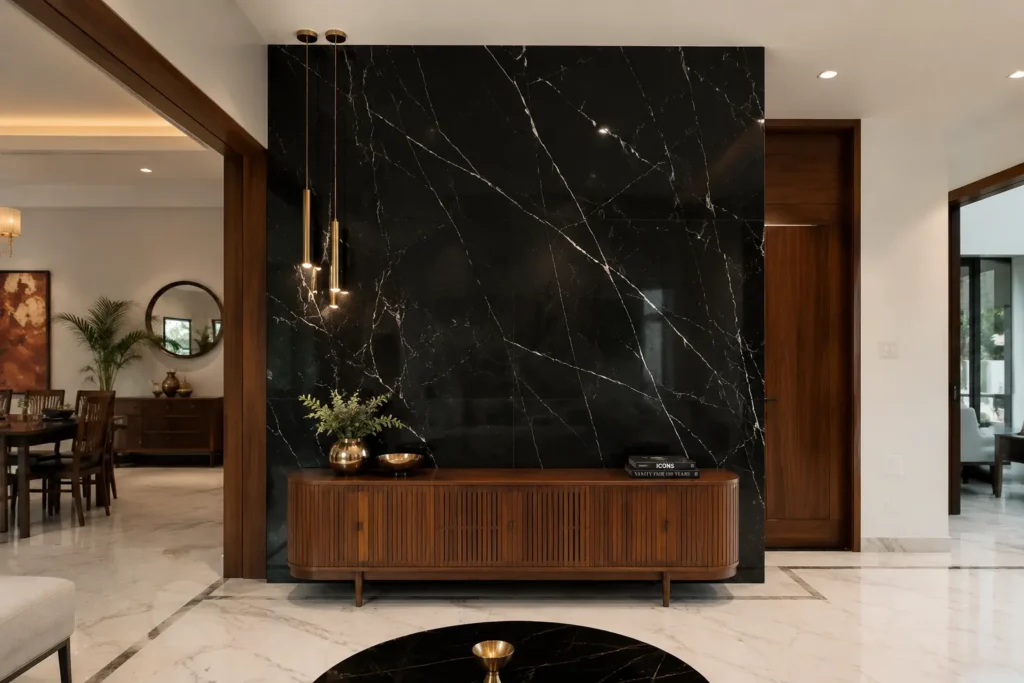
A client once sent me eleven Pinterest boards before our first meeting, all titled some version of “black marble dream home.” Not one of those boards showed an Indian house. That gap is exactly why I’m writing this.
If you’ve searched black and marble combination, you already know what marble is, so I won’t waste your time explaining that. What most people don’t know is the ratio that makes it work. Pair a low veined black stone, Nero Marquina or Indian Black granite, with a warm white marble like Makrana or Statuario. Break the black up with wood or brass somewhere in the room. And keep black under sixty percent of what your eye actually lands on in any one sightline. Cross that line and a luxurious room starts feeling like a mortuary. I’ve seen it happen, and it’s an expensive mistake to undo.
I’ve specified this combination in villas, 4BHK renovations and premium apartments across Bangalore for over a decade now, and the clients who get it right are the ones who plan the whole palette, floor, wall, countertop, before they fall for one slab at the yard. This guide covers where black marble earns its place, where it genuinely doesn’t, current pricing, and where Kota stone and limestone fit in. If stone is new territory for you, our Interior Design Materials hub is a decent starting point before you commit to anything.
Why Natural Stone Still Wins
I’ll be honest, no engineered slab has ever fooled me in person, even the good ones. Photos lie, but standing next to real veining under actual daylight is a different thing entirely. According to Mordor Intelligence’s India Construction Ornamental Stone Market report, even as tax changes push mid tier buyers toward ceramic substitutes, the luxury segment keeps specifying natural stone almost unaffected, with marble gaining share specifically in premium residential work. That matches what I see on site. Clients renovating a full villa rarely cut the stone budget. They cut the square footage of it instead, which is honestly the smarter move.

Marble Varieties Worth Knowing
- Statuario or Carrara, imported, grey veined white. Best where direct light actually hits the wall, otherwise you’re paying for veining nobody sees.
- Indian White (Makrana), quarried in Rajasthan for generations, kinder on a flooring budget, slightly less translucent than the Italian stuff, but most clients can’t tell the difference once it’s polished and laid.
- Indian Black or Nero Marquina, your anchor stone. Nero Marquina has fine white veins running through it, Indian Black reads almost solid, which is why it suits a modern build better.

Getting the Black and Marble Combination Right
This is what actually gets asked on site visits, and it’s rarely about the stone. It’s about placement.
- Kitchen islands: black marble on a waterfall edge, white marble or quartz on the perimeter. Keeps drama contained to one object instead of the whole room.
- Bathrooms: black marble flooring, white marble on a single vanity wall, never both walls. I’ve walked into a bathroom where a client insisted on both, and it genuinely felt smaller and colder than before the renovation.
- Feature walls: book matched black marble behind a console or headboard, flanked by lighter walls either side.
- Living rooms: black marble flooring with cream or white walls is the safest high impact call for a Bangalore apartment, since it doesn’t lean on the same natural light an all marble room needs.
On a Whitefield villa project, the family wanted black marble across the entire ground floor. I talked them down to just the foyer and staircase risers, with Makrana carrying the living and dining floor. That one threshold does more visual work than covering the whole level would have, and it saved them roughly forty percent of the material cost on that floor alone.
Already picturing this in your own home? Get a free quote estimate before you visit a stone yard, so you’re negotiating with a real number instead of a guess.

Where Marble Should Not Go
Marble is porous and reacts to acid, full stop. Skip it on unsealed kitchen counters that see daily turmeric, lime or oil, and skip open balconies entirely given Bangalore’s monsoon humidity. I’ve had two separate clients call me eighteen months after installation asking why their balcony marble had gone patchy. Both times, it was never sealed properly.

Granite vs Marble
Granite is the workhorse behind marble’s showpiece role. It’s harder, less porous, and it settles most granite vs quartz worktops debates for anyone wanting a natural surface for daily use counters. Black Galaxy and Absolute Black granite pair beautifully with white marble flooring for exactly this reason. Read our granite vs quartz guide for the full comparison.

Kota Limestone Tiles Review
Kota stone is a Rajasthan quarried limestone in green grey or blue grey, and it’s the most underrated material in this category, hands down. In this kota limestone tiles review, my honest take after using it on maybe two dozen projects: it stays noticeably cooler underfoot through Bangalore’s warmer months, costs a fraction of imported marble, and works as a natural transition stone between a black and white interior and a courtyard, where marble has no business being anyway.

Limestone and Travertine
These are the quiet luxury pick, softer, matte, warmer toned than marble, and well suited to feature walls where you want texture without the shine. Against black marble flooring, they read calmer than an all marble room ever could.

Mixing Stones Without Clashing
One dominant stone, one accent stone, one non stone material. That’s it. Go beyond that and it stops looking curated and starts looking indecisive.
- Pair black marble with wood wall panels interior work, walnut or teak, to soften hard edges around a media wall.
- In warmer, nature leaning homes, a bamboo wall panel section works as a lighter accent, especially near a reading nook.
- The board behind these panels matters as much as the finish on top. Check our particle board vs plywood comparison in the MDF vs particle board guide before your carpenter locks the BOQ.
- Want stone drama without slab weight everywhere? Stainless steel accents on hardware give you the same punctuation with far less upkeep.

What Natural Stone Actually Costs in Bangalore
| Stone | Price Range (per sq ft, material only) | Best Use |
| Indian White Marble (Makrana) | Rs 150 to Rs 500 | Flooring, walls |
| Imported White Marble (Carrara, Statuario) | Rs 1,000 to Rs 5,000 plus | Feature walls, vanities |
| Black Marble (Indian, Nero Marquina) | Rs 200 to Rs 1,200 | Islands, flooring accents |
| Granite (Black Galaxy, Absolute Black) | Rs 120 to Rs 450 | Countertops, high traffic floors |
| Kota Stone | Rs 35 to Rs 90 | Balconies, utility areas |
| Limestone or Travertine | Rs 180 to Rs 600 | Feature walls |
These rates exclude polishing, installation and wastage. Budget fifteen to twenty percent above material cost. I’ve seen more than one project go over purely because this margin was never built in at the planning stage, and it’s an entirely avoidable headache.
Not sure what this looks like for your own floor plan? Run your numbers through our price calculator and get a realistic figure in under two minutes.

Maintenance Nobody Warns You About
Marble and limestone both need resealing roughly every twelve to eighteen months in Bangalore’s humidity. Skip this and you’ll see etching around sinks within two years, sometimes less. Granite and Kota stone are far more forgiving, three or more years between sealing cycles. This is the single most common regret I hear from homeowners who picked stone off Pinterest without ever asking about the upkeep waiting on the other side.

Real Project: A Whitefield Villa in Black and White Marble
A 4BHK villa client came to me with exactly this brief, black and marble, but not cold. We used Indian Black granite for the kitchen island and staircase risers, Makrana white marble for the living room floor, and a book matched black marble accent wall behind the dining table, framed with teak panelling either side. It reads warm despite the black, because no single surface crosses forty percent black coverage in any one sightline. See more of this kind of work in our portfolio.

FAQ
What goes well with black marble?
Warm wood tones, brass or gold fixtures, and white or cream marble create the most balanced black and marble combination. I generally steer clients away from chrome and very cool toned greys here, it tends to make the room feel colder rather than luxurious.
Is black marble good for flooring in Indian homes?
Yes, provided it’s sealed and polished correctly. It hides scuffs better than white marble but shows dust and water spots more visibly, so it suits low humidity, well ventilated rooms best.
What is the cost of black marble in India?
Indian black marble typically runs Rs 200 to Rs 1,200 per square foot depending on veining and finish, while imported Nero Marquina costs considerably more once shipping and polishing are added in.
Can black and white marble be combined in the same room?
Yes, it’s one of the most established combinations in Indian luxury interiors, whether as flooring and wall contrast or an inlay border, as long as one colour clearly leads the room.
Is Kota stone good for a modern home?
Yes. It works especially well in balconies, utility areas and transition zones between indoor marble and outdoor space, and it costs far less than marble while resisting heat well.
Ready to Plan Your Black and Marble Interior
If you’re past browsing and actually shortlisting a designer who understands stone specification, not just tile catalogues, start with a real number. Run your home through our price calculator, then book a consultation with Blue Interiors to walk through slab selection in person before you visit a single yard.
Get Your Free Stone Interior Quote
Written with input from Blue Interiors‘ design team, who have specified natural stone across premium Bangalore homes, including villa and turnkey apartment projects, over the past fifteen years.