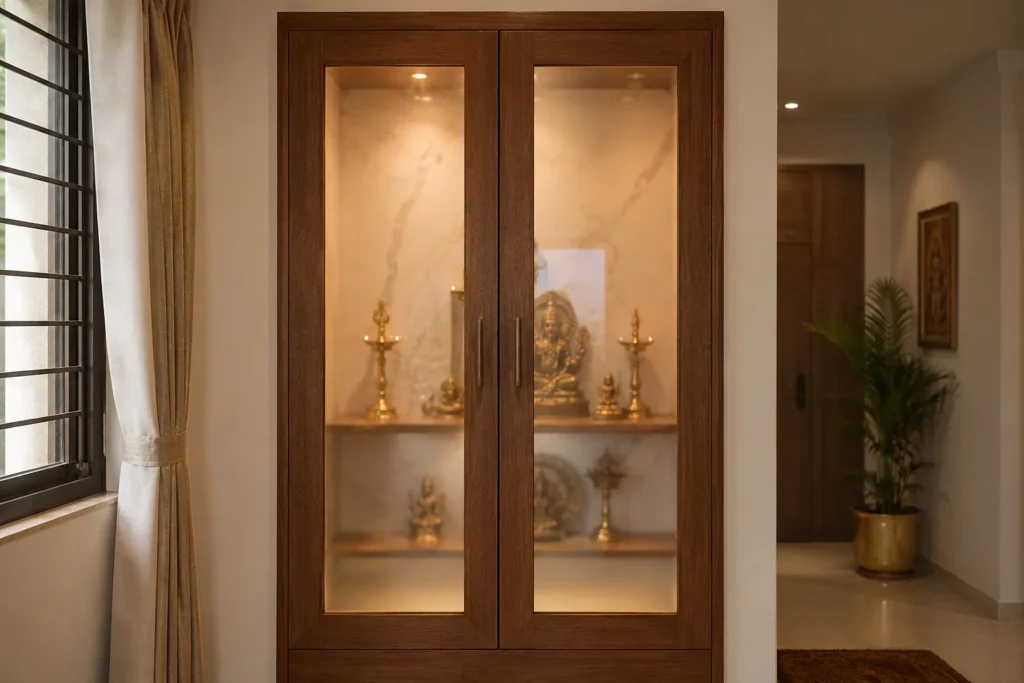
Quick Answer: Modern pooja room glass door designs swap solid wood for toughened glass, usually frosted, etched or lacquered, so light gets into the mandir even when the door is closed. This matters most when the pooja corner is stuck somewhere dark, a passage wall, an interior niche, a 1BHK spot with no window anywhere near it. Frosted and etched glass keep things private. Clear and reeded glass opens the space up more. Most fabricators use toughened glass in the 6mm to 8mm range, and that is not a random number, it is what holds up to daily use.
What the Other Guides Skip
Every article we looked at on this topic is basically a photo gallery. Ten designs, one line under each, next page. Fine, if you already know what you want. Not so fine if you are actually trying to decide.
Nobody tells you which finish genuinely hides the idols from someone standing in the hallway. Nobody tells you how wide a double door needs to be before it stops looking squeezed. The frame gets treated as an afterthought when it is honestly half the look. And cost gets waved at vaguely instead of broken down by what you are actually paying for.
So that is what this one does differently. Glass here is not a Pinterest trend, it is a fix for a specific problem, a dark pooja corner that a heavy wood door only makes worse. If you want to see the full range of styles beyond glass first, our complete guide to pooja room door designs covers wood, jaali, CNC and metal options side by side.
Want to talk through your specific corner instead of guessing from photos? Book a free door design consultation and get in touch with our team.
Why Glass Fixes What Wood Cannot
Solid wood and CNC doors look the part, no argument there. But they block whatever little light was reaching that spot to begin with. Open it for aarti, close it after, and the rest of the day it is just a dark box on the wall. A lot of the Whitefield and HSR Layout homes we work in have the pooja room tucked into the northeast corner because that is what Vastu asks for, except that corner is a passage wall, not an outer one. There was never a window there.
A heavy door does not help that. Glass does.
A modern pooja room glass door design is exactly what it sounds like, a mandir door built from toughened glass instead of wood, usually frosted or etched. It lets light diffuse through the panel while keeping a direct view of the inside blocked. Small, dim pooja units are where it earns its place.
If you are curious about frosted glass beyond just the mandir door, we have written about where frosted glass gets used across a home, which is worth a look before you brief a fabricator on finish.
The Finish Question Nobody Actually Answers Properly
This is the part that decides whether you are happy with the door in six months or redoing it.
Frosted glass is sandblasted matte. It softens everything, you get shapes and colour, not detail. For most homes, this is the one to default to unless you have a specific reason not to.
Etched glass is frosted glass with a design cut into it, an Om, a lotus, a temple arch, whatever fits your taste. The motif becomes the decorative element while the rest stays opaque.
Lacquered or coloured glass, gold, maroon, ivory, is fully opaque. Nothing gets through visually, but the surface still catches and reflects light, so it does not feel dead the way a solid wood panel can.

When Clear Glass Actually Makes Sense
Clear tempered glass works if your pooja room is its own closed room off a hallway, not something that opens straight into the living or dining area. No direct sightline from a common space, clear glass in a double door pooja room glass door design gives you the most light and the most open feel of any option here.
Reeded and Fluted Glass
The middle ground. Vertical ribbing blurs detail similarly to frosted glass, but it has a texture to it that photographs better and does not risk looking like a bathroom partition, which plain frosted glass sometimes does if the frame is wrong.
Double Door or Single, and Why the Tape Measure Matters More Than Taste
A double door pooja room glass door design looks closer to an actual temple entrance, which is why people want it. But it needs room to breathe. Most fabricators will tell you not to go double under about 36 to 40 inches of clear opening, otherwise the panels come out too narrow and it just looks squeezed instead of grand.
Under that width, go a single panel or a sliding glass shutter. Same light, same privacy, none of the cramped look.

A Houzz India Renovation Trends study found dedicated pooja spaces are among the most requested customisations in Indian home renovations right now, with more homeowners specifically asking for layouts that work in smaller floor plans. That is where glass has a real edge over a bulky wood unit.
The Frame Decides More Than the Glass Does
Glass almost never goes bare. And honestly, the frame is doing more work on the final look than people give it credit for.
Teak or sheesham gives you the warmest, most traditional feel, pairs well if your mandir unit is also wood, and needs the occasional polish.
Brass or gold-toned metal leans into that temple-arch look, but it will need upkeep or it tarnishes.
Anodised aluminium in a slim profile is the cleanest, most modern option and basically maintenance-free, good fit for a minimalist mandir.
Frameless glass on pivot hinges is the most contemporary choice on this list, but it is unforgiving. The wall and floor around it need to be genuinely level, because there is no frame left to hide the gaps.

Expert tip from Manish Jain: I tend to talk clients out of frameless glass unless I have already seen the wall finish myself. A frame hides small site errors. Frameless glass puts every one of them on display.
What This Actually Costs
Glass is genuinely lower maintenance than carved wood, no termite worry, no repolishing schedule. But it shows fingerprints and incense residue more than wood grain does, so it needs wiping down more often, not less.
For a mid-size frosted or etched glass door, get a quote against your actual dimensions rather than trusting a number from an article. Rates move by vendor, by finish, by month even, so anything fixed we printed here would be wrong for your specific unit by the time you read it.
Case study: We had a client in Sarjapur Road whose pooja niche faced north and barely saw daylight all day. We swapped the solid wood shutter for a double frosted glass door in an anodised aluminium frame, did not touch the mandir unit itself, just the door. What stuck with us was the client’s own line afterward, that the space finally looked awake during the day instead of only lighting up for evening aarti.

Expert tip from Manish Jain: Lock the mandir unit’s final width before you finalise the door opening, not the other way round. That order gets reversed more often than you would think, and it is the most common regret we hear about afterward.
Ready to Design Your Pooja Room Door
Modern pooja room glass door designs are not really about chasing a trend. For a pooja corner that gets no light, glass is often the only fix that actually works without a full renovation. The finish decides how private it feels, the frame decides how traditional or modern it looks, and the width decides whether a double door is even an option.
You can also browse our full interior design services if the door is one piece of a larger pooja room or home renovation.
Book a free door design consultation and we will look at your actual space, not a catalog photo, and tell you honestly whether glass, wood, or some combination of both is right for you. Talk to us here.
FAQs
Can a glass pooja room door be paired with a wooden frame for a traditional look?
Yes, and it is one of our more common requests. A teak or sheesham frame around frosted or etched glass keeps the traditional mandir feel while still solving the light problem a solid door creates.
Do glass pooja room doors need special hardware?
Yes. The hinges and pivots need to be rated for the glass panel’s actual weight, and the edges need protection so the glass does not chip against the frame over time. Worth confirming with your fabricator before installation, not during.
How do I clean a frosted or etched glass door without wearing down the finish?
A soft microfiber cloth and a mild glass cleaner does the job. Go easy on the etched sections specifically, aggressive scrubbing over years can dull the cut pattern.
Can I add a glass door to an existing mandir unit, or does it need a full renovation?
Most of the time you can retrofit it, as long as the opening dimensions are accurate. It usually does not need a full renovation, though the frame depth might need a small adjustment to fit properly.
Is a glass door safe for daily use in a pooja room?
Yes, toughened glass in the 6mm to 8mm range is built exactly for this kind of daily handling and holds up against normal impact. That is why it is the standard spec fabricators default to.
Author Bio
Manish Jain is the Founder and Creative Director of Blue Interiors, with 15+ years of excellence in luxury residential and commercial interiors across Bangalore. He has personally overseen pooja room and mandir installations across HSR Layout, Whitefield and Sarjapur Road homes.
For placement and direction rules around the pooja room itself, separate from the door, see our guide on Pooja Room Vastu Shastra. And if the door is the last piece and the rest of the room still needs sorting, our guide on getting the pooja room design right the first time covers the placement and layout decisions that should happen before the door does.