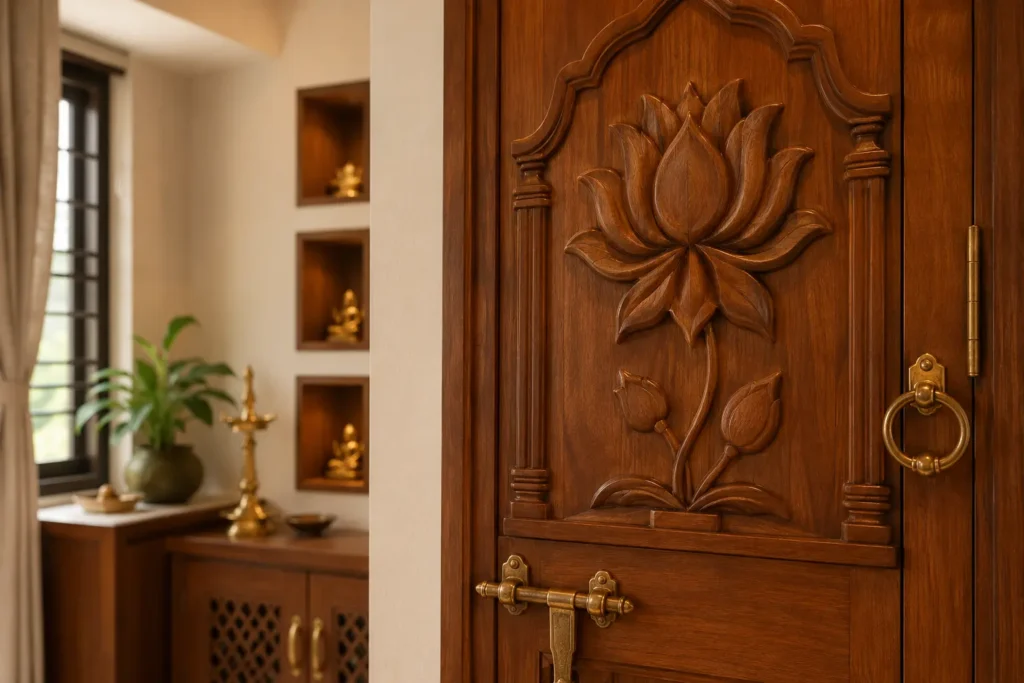
Quick Answer: Pooja room door designs fall into nine styles: solid carved wood, jaali lattice, glass and wood combination, stained glass, metal accented wood, CNC cut panels, arch top temple doors, sliding doors, and folding doors. Teak and Sheesham suit larger mandirs. Jaali doors work where you need airflow for incense. CNC cut and sliding styles suit modern apartments. A pooja room double door design needs at least 40 inches of clear width to look right, so measure before you pick a motif.
Key Takeaways:
- Nine door styles covered, from carved teak to machine cut modern panels
- Material and cutting method decide durability as much as the motif does
- Simple pooja room door designs in engineered wood cost less and suit rental homes
- Double doors need width. Under 40 inches, go single, sliding, or folding instead
- Doors that open smoothly without creaking matter more to Vastu than most people think
What Are the Main Types of Pooja Room Door Designs
I get asked about pooja room doors almost every time a client’s carpenter finishes the carcass work and suddenly needs an answer by Friday. Most people have not thought about it until that point. Understandable, since the door usually gets picked last, after the marble shelf and the lighting and the idol placement are all sorted.
There are nine styles I keep coming back to on site. Some solve a space problem, some solve a budget problem, and a couple just look better with certain kinds of carving than others.
1. Solid Carved Wood Doors
Teak, rosewood, and Sheesham hold detail without splitting, which is why they show up in almost every catalog you will find online. Deep relief carving of lotus motifs, Om symbols, or temple style borders looks stunning in photographs, and it photographs even better once the diyas are lit and the shadows sit inside the grooves. In real life it also collects dust in those same grooves, so I tell clients to keep a soft bristle brush near the mandir, not just a cloth. Carving depth matters too. Anything deeper than about 10mm looks dramatic but chips more easily near door edges over a decade of daily use.
2. Jaali Lattice Doors
A jaali panel lets incense smoke and light move through without the door standing fully open all day. Good for pooja rooms tucked into an interior wall with no window of their own, since the lattice does the job a window would otherwise do. The pattern itself can range from a simple repeating geometric grid to something closer to a floral trellis, and the choice usually comes down to how busy the rest of the room already looks. A dense trellis against a patterned wall tile starts to feel cluttered fast. If you are torn between MDF and solid wood for the lattice frame, our MDF vs particle board comparison covers which one actually holds up against Bangalore humidity.
Not sure your pooja alcove can even fit a full jaali panel? Book a free measurement visit and we will tell you honestly before you spend on carving.

3. Glass and Wood Combination Doors
Frosted or etched glass set inside a carved wood frame gives you light without the door feeling like a wall. This is the one I recommend most for apartments where a solid teak door would eat up too much visual space in an already small room. The wood frame carries the traditional weight, while the glass panel keeps the whole thing from feeling closed off, which matters if your pooja corner sits close to a main living area. Our lacquered glass texture guide is worth a look if you are considering glass elsewhere in the home too, since matching finishes tends to look more intentional than picking each one separately.
4. Stained Glass Doors
Different from plain frosted glass. Stained panels use colour, usually deep red, amber, or blue, to turn the door itself into a small feature rather than a background element. Works well when the pooja corner opens onto a hallway or living room, since the coloured light softens what could otherwise be a harsh transition between a devotional space and a casual one. One downside worth knowing before you commit: coloured glass shows fingerprints and water spots far more than frosted does, so it needs a quick wipe more often than most homeowners expect.

5. Metal Accented Wood Doors
Brass or copper inlay along the border, or as a single central medallion, adds shine without the cost of carving the full panel by hand. It is a way to get an ornate, temple-like feel on a tighter carving budget. Metal accents also age better than gold leaf, which tends to dull under regular diya smoke within a couple of years, whereas brass just develops a deeper patina that most clients end up liking anyway. The trade off is that metal needs an occasional polish if you want it to keep its shine rather than settle into a duller bronze tone.
6. CNC Cut Minimalist Doors
Machine cut geometric or floral patterns cost less than hand carving because a machine, not an artisan, is doing the cutting, and the turnaround time is shorter too since there is no drying or hand finishing stage involved. I have started seeing more requests for this from younger couples who want the airflow benefit of a jaali without the heavier, more traditional look that comes with hand carved relief work. The pattern precision is also more consistent than hand carving, which some clients prefer for a cleaner, symmetrical finish.
Weighing carved wood against a CNC cut design for your budget? Talk to our design team and we will walk you through real cost differences, not catalog guesses.

7. Arch Top Temple Doors
Instead of a flat rectangular top, the frame curves into an arch, borrowing from South Indian temple architecture where arched entrances signal a threshold into sacred space. This is a structural choice, not a material one, so it can sit on top of a carved wood door, a glass wood combination, or even a CNC cut panel, depending on what look you are going for. It reads as more overtly devotional and tends to draw the eye upward, so I usually suggest it for a dedicated mandir room with enough ceiling height rather than a small wall niche where the arch would feel squeezed.
8. Sliding Doors
Sliding doors track along the top and skip the swing clearance a hinged door needs, which is a bigger deal than it sounds once you actually try to walk past an open hinged door in a narrow passage. In a corridor facing the mandir, that clearance issue is not small. We used this in a Whitefield 2 BHK last year where the pooja corner sat right off a narrow passage, and a hinged door would have blocked the walkway every time someone opened it during morning aarti.
9. Folding Doors
Bi fold doors open fully during Diwali or Ganesh Chaturthi, then fold flat the rest of the year, which makes them a decent middle ground between a jaali that stays permanently half open and a solid door that someone has to prop back manually every festival. The folding hardware does need a bit more maintenance over time compared to a simple hinge, so it is worth budgeting for an occasional track adjustment.
How Do You Choose Between Single and Double Doors
A pooja room double door design only works when the width actually supports two shutters standing open at once. Below 40 inches, forcing a double door in almost always looks squeezed, no matter how good the carving is.
| Door Width | Recommended Style | Typical Fit |
| Under 24 inches | Sliding or frosted glass panel | Wall niche, compact apartment |
| 24 to 40 inches | Single hinged carved or CNC cut door | Standard 1 to 2 BHK pooja corner |
| 40 inches and above | Double door design, arch top | Dedicated mandir room, villa |
What Materials Last Longest in a Pooja Room
Daily lamp heat and incense smoke dry out cheap laminate faster than most people expect, so material choice matters more here than in almost any other part of the house.
| Material | Cost Level | Maintenance | Best For |
| Solid Teak | High | Low, ages well | Larger mandirs, long term homes |
| Sheesham | Mid to High | Low | Traditional carved styles |
| MDF with veneer | Low to Mid | Moderate, keep away from direct moisture | Budget homes, CNC cut panels |
| Frosted or stained glass with wood frame | Mid | Low to moderate, wipe clean | Small apartments |
| Wood with metal inlay | Mid to High | Low | Traditional look, low upkeep |
The Houzz India Renovation Trends Study found that wood finishes and traditional detailing remain among the most requested elements in Indian home renovations, which lines up with almost every pooja room brief we get.

A Real Project, and What It Taught Us
A client on Sarjapur Road came in wanting a carved double door for her mandir. Turned out the alcove was only 30 inches wide once we measured it properly. We switched her to a single carved door with a matching decorative side panel instead of cramming two narrow shutters into a space that could not hold them. She still got the ornate look she wanted, just without the door looking pinched every time she opened it.
We check width before we finalize any pooja door design now. It sounds obvious written down, but it is the step most online galleries skip, since a photo cannot tell you whether a design will fit your actual wall. For a wider look at how the surrounding layout should support this, our guide on getting your pooja room design right covers the placement decisions that come before the door.
Two quick things worth knowing before you sign off on a design. If your pooja room shares a wall with a bedroom, skip deep relief carving on that side, since it traps dust and is harder to clean without disturbing the idols sitting close by. And ask your carpenter for a soft close hinge on any wooden pooja door. It is a small thing, but a door slamming shut near a lit diya is a genuine fire risk, and it is one of the first things we check on site visits. Correct door direction also plays into this, and our Pooja Room Vastu Shastra guide walks through the placement rules in detail.
Frequently Asked Questions
Do pooja room doors need to be a different colour from the rest of the house?
No. Matching your existing wood tones and wall colours usually looks more cohesive than a contrasting door. A jarring colour mismatch tends to make the mandir look bolted on rather than part of the home.
Is a pooja room door necessary, or can the space stay open?
It is a personal choice, not a rule. A door helps contain incense smoke and gives visual separation during non pooja hours, but plenty of homes keep an open shelf style mandir without one.
How much does a custom pooja room door typically cost?
Costs vary widely by material and carving depth, from a modest CNC cut panel to a premium hand carved teak door. Get an on site quote rather than relying on generic online price ranges.
Can an existing plain door be upgraded with carving or jaali work later?
Sometimes, if the door is solid wood and structurally sound. Engineered wood doors are harder to retrofit and usually need full replacement instead of an add on upgrade.
How often does a wooden pooja room door need refinishing?
Every 3 to 5 years for solid wood in daily use, sooner if the door sits close to direct diya smoke or sunlight. A simple oil or polish refresh usually extends this window comfortably.
Where This Leaves You
Pooja room door designs come down to three real decisions: material, width, and how much airflow the room needs for daily rituals. Carved teak and Sheesham suit larger, dedicated mandirs. Jaali, CNC cut, and glass wood combinations solve the small apartment problem without losing the sacred feel. A double door design only earns its place once the width can support it. And if you want to see the fuller scope of what we handle beyond doors, our interior design services page covers that.

Ready to Get Your Pooja Room Door Right the First Time
Every wrong pooja door decision we have seen came from the same mistake: picking a design off a catalog photo before anyone measured the actual space, checked the material against the room’s humidity, or thought about how often the door would really be opened. That mistake is expensive to undo once the carving is done and the carpenter has moved on to the next job. It does not have to be yours.
Blue Interiors will visit your home, measure your pooja alcove properly, and walk you through material and design options that fit your space, your budget, and how you actually use the room, not just what looked good in someone else’s photo.
Book your free pooja room door consultation today and get a design you will not want to redo in two years.
Author Bio
Manish Jain is the Founder and Creative Director of Blue Interiors, with 15+ years in luxury residential and commercial interiors. He has personally overseen pooja room installations across Bangalore homes in HSR Layout, Whitefield, and Sarjapur Road.