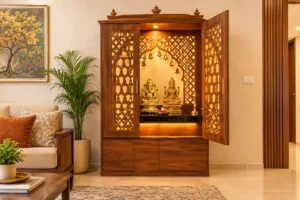

Pooja room interior designers in Bangalore do more than pick a wood finish. They coordinate joinery, stonework, LED electrical and, in most apartments, a building society NOC, all for one space most homeowners finalise in a week. Blue Interiors builds custom pooja rooms across Bangalore: compact wall-mounted units in 2BHKs, full dedicated granite rooms in Sarjapur Road villas, and everything between. A wall unit with a CNC jali door and backlit panel costs Rs 55,000 to Rs 1.2 lakh in 2026. A full dedicated pooja room with granite flooring, POP ceiling and custom woodwork runs Rs 1.8 lakh to Rs 3.5 lakh and above.
Key Takeaways:
- CNC jali doors with warm LED backlighting are the most requested pooja room upgrade in Bangalore apartments right now: they add visual depth without taking any floor space.
- Granite platforms handle oil, camphor heat and turmeric staining far better than marble in daily ritual use.
- Northeast, east or north are the Vastu-correct directions. A unit placed on a bathroom-shared wall is both Vastu-wrong and a moisture problem in Bangalore’s June-to-September wet season.
- Brigade and Prestige apartment lifts in Whitefield cap usable panel widths at 7.5 to 8 feet. Any designer who has not asked about lift access before fabrication begins is a gap worth flagging.
- The minimum platform depth for a standing idol with a diya in front of it is 12 inches. Nine-inch units look right on a render and fall short in practice.
- One team handling joinery, stone and electrical together is the only way to avoid a pooja room that is “almost done” three weeks after the rest of the home is handed over.
The pooja room is the last space discussed in almost every Bangalore interior project, and the one that generates the most rework. Families come in with specific references: a jali pattern from Instagram, a particular granite, a wood tone they saw at a relative’s home, and then find out midway that their designer handles carpentry but not stonework, or that the CNC panel they approved does not fit through the building’s lift.
This post covers what a qualified pooja room interior designer in Bangalore actually handles, what it costs in 2026, and what to check before anything goes to fabrication.
What Does a Pooja Room Interior Designer Actually Do?
Most homeowners assume hiring a pooja room designer means picking between three unit styles in a catalogue. The actual scope is wider.
A designer handling a full build coordinates the carpenter for the mandir body, the stone vendor for the granite or marble platform, the electrician for LED wiring and switch placement, and in most Whitefield and Sarjapur Road apartments, the building society NOC process before any civil or stonework begins.
Manish Jain points out that the pooja room is one of the few spaces in a Bangalore apartment where going piecemeal costs you the most time. A carpenter handles the unit. A separate stonecutter does the platform. The building electrician does the switch. Each handoff between vendors is a gap where delays stack up. When one team owns all three workstreams, nothing falls between them.
At Blue Interiors, the pooja room is scoped and built as one line item inside the full-home project. See completed work on the Blue Interiors portfolio.
Pooja Room Cost in Bangalore (2026)
Here is what homeowners are paying for custom pooja unit makers in Bangalore this year:
| Build Type | Approximate Cost (2026) | Best For |
| Wall-mounted unit, laminate body | Rs 20,000 to Rs 45,000 | 1BHK and 2BHK apartments |
| Wall unit with CNC jali door and LED backlight | Rs 55,000 to Rs 1.2 lakh | 2BHK and 3BHK apartments |
| Carved teak or sheesham unit with PU finish | Rs 60,000 to Rs 1.5 lakh | Families wanting traditional wood |
| Granite platform with custom mandir unit | Rs 90,000 to Rs 1.8 lakh | Premium apartments and villas |
| Full dedicated pooja room: ceiling, flooring and woodwork | Rs 1.8 lakh to Rs 3.5 lakh+ | 3BHK+, villas, joint families |
These are Bangalore 2026 figures, not national averages. Teak costs more than sheesham. Black Galaxy granite costs more than Absolute Black. A domed POP ceiling detail adds Rs 15,000 to Rs 35,000 depending on the room size.
One cost that gets missed every time: the electrical. A backlit unit needs concealed wiring, an aluminium LED profile channel, a dimmer, and often a separate breaker point. Leave this out of the initial quote and you are looking at a Rs 8,000 to Rs 15,000 rework after the unit is in.
CNC Doors: What to Check Before You Approve the Design

A pooja room with a CNC door in Bangalore is the most requested upgrade in 2026. The appeal is straightforward: a laser-cut jali panel with warm backlighting looks like custom carved work and costs a fraction of solid carved wood.
Three things to check before you approve the pattern:
Pattern Scale
Fine jali motifs with small repeating cutouts look sharp in a render and collect dust in real life. Patterns with individual openings above 15mm can be wiped clean with a dry cloth. Below that, you need a soft brush at aarti time every day.
Material for the Jali Panel
MDF is cheaper and cuts clean. Most vendors default to it. It is also more sensitive to humidity. A CNC panel inside a closed pooja room where oil lamps run daily is better fabricated in IS:710 BWP-grade plywood, which is the boiling-water-proof standard under the Bureau of Indian Standards. This needs to be named in the quote before it is locked, not discussed after the panel arrives.
Lift Access and Panel Width
Panels above 8 feet cannot be carried through the standard lift dimensions in most Brigade and Prestige towers in Whitefield. Blue Interiors fabricates in sections with concealed splines when needed. The join is invisible once installed. If your designer has not asked about lift access, raise it before fabrication starts.
For more on jali patterns and door styles, see our guide on pooja room door CNC designs, jali and bell ideas.
Granite vs Marble: Which Works Better in a Pooja Room?

The short answer is granite, with one exception.
Granite is denser than marble. Oil from diyas, camphor soot, turmeric from offerings: all of these sit on the stone surface during daily ritual. Granite absorbs less, resists acidic staining better, and does not need annual sealing. Black Galaxy, Absolute Black, and Paradiso are the finished homeowners in HSR Layout and Koramangala most often specify for the platform base.
Marble is the right call when the pooja room is a dedicated, enclosed space: a 4×5 foot room inside a villa, for example. Makrana or Italian white marble on the back wall and flooring creates a coolness and depth granite cannot match. The trade-off is maintenance. Marble stains permanently if turmeric or oil sits on unsealed stone. It needs sealing at installation and again every year or two. Families with heavy daily ritual use and no appetite for annual upkeep should stay with granite.
The combination that works best in most Bangalore apartments: granite on the platform (practical, low maintenance) and marble or Corian on the rear panel for depth and visual interest.
For a full stone comparison, see our guide on pooja room tiles design and granite choices.
Thinking about your pooja room material? Blue Interiors handles the full scope: carpentry, stonework, lighting and electrical. One team, one quote. Get a Project Estimate | Call or WhatsApp: +91-8123387210
Vastu Placement for Bangalore Apartments
Vastu placement is not a checkbox. Where the unit goes changes the ritual use of the space and how the rest of the room works around it.
The Vastu-correct directions are northeast (Ishanya), east, or north. The idol should face east or north during prayer. The platform should sit at chest height when seated, roughly 2.5 to 3 feet from the floor.
Two placement mistakes come up repeatedly in Bangalore apartment briefs:
Placing the unit on the wall shared with a bathroom. This is Vastu-incorrect and also a practical issue. The wall behind a bathroom accumulates moisture from June through September in Bangalore. Plywood-backed units on that wall start showing delamination within two to three monsoons.
Placing the unit directly under an air conditioner. Condensation drip and constant airflow push dust onto the idols daily. It is a small and constant problem, entirely avoidable at the brief stage.
For compact east-facing 2BHKs in Whitefield where the northeast corner is taken by the utility shaft (very common in Sobha and Puravankara layouts), the best workable option is a raised unit on the foyer wall, correctly oriented and separated from adjacent wall fixtures.
Our guide on pooja room Vastu direction and design for 2026 covers placement rules across different apartment configurations.
Lighting: Where Most Builds Fall Short
A plain unit with good lighting beats an ornate one with a single overhead bulb. That is not a subjective opinion. It is what homeowners say six months after handover, without exception.
The correct colour temperature for a pooja room is 2700K to 3000K (warm white). Anything cooler makes granite look flat and marble look clinical. Most apartment main lights run at 4000K or above. The pooja room needs its own circuit.
Three-Layer Lighting Setup
Backlight: LED strip in an aluminium channel behind the CNC jali panel or back wall, on a dimmer. This is the light people are referring to when they say they want the room to glow.
Idol spot: One adjustable ceiling spot, 3W to 5W, aimed directly at the idol. Not at the back wall. Light the idol, not the space behind it.
Task light: A concealed under-shelf strip on the platform area where the diya is placed and daily preparation happens.
Hafele India’s furniture lighting range covers aluminium LED profile channels and dimmer systems compatible with the above setup. Blue Interiors sources hardware from Hafele as a Studio Partner.
Diya Safety
The diya goes on the granite or marble platform, which handles the heat. The CNC jali panel behind it needs at least 10 to 12 inches of horizontal clearance from the flame. This is a fabrication specification that goes into the technical drawing, not a styling detail for the mood board. Raise it at the design stage.
How Long Does a Pooja Room Build Take?

A standalone wall-mounted unit with CNC door and LED backlight: 10 to 15 working days once materials are confirmed.
A granite platform with custom mandir unit: 18 to 25 working days. Black Galaxy and Absolute Black granite are always available from stone yards in Peenya and Jalahalli. Italian marble runs 10 to 15 extra days for procurement.
A full dedicated pooja room as part of a home interior project: included within the Blue Interiors 45 working-day project timeline, not counted separately.
For apartments in Sobha, Puravankara and similar developments that require an execution NOC and restrict site hours to Monday through Saturday, 9 AM to 6 PM (most Whitefield and Sarjapur Road complexes do not permit Sunday work), the approval process adds 3 to 5 working days before work can begin on site. Blue Interiors handles NOC documentation as part of project onboarding.
For compact apartment layouts, see our guide on small pooja room designs for apartments, which covers size configurations for 2BHK and 3BHK floor plans.
Frequently Asked Questions On Pooja Room Interior Designers in Bangalore
What is the cost of a custom pooja room in Bangalore in 2026?
A wall-mounted unit with CNC jali door and LED backlight costs Rs 55,000 to Rs 1.2 lakh. A full dedicated pooja room with granite flooring, POP ceiling and custom woodwork runs Rs 1.8 lakh to Rs 3.5 lakh and above. Final cost is confirmed after a site visit and material selection, not before.
Which direction should the pooja unit face in a Bangalore apartment?
Northeast (Ishanya), east, or north is correct per Vastu. The idol should face east or north during prayer. If the northeast corner falls at the utility shaft or bathroom wall, a raised foyer unit on the east or north wall is the standard workable alternative.
How do I choose between a CNC jali door and a solid teak unit?
A CNC jali panel with warm LED backlight gives strong visual impact at mid-range cost and suits contemporary apartment interiors. Solid teak or sheesham with carving is the right call for families who want a traditional temple-style mandir. Both hold up well when finished correctly: PU coating on wood, sealed edges on the jali panel.
Can a pooja room fit inside a 2BHK without losing floor space?
Yes. A wall-mounted unit on the foyer or living room wall uses no floor area at all. The minimum platform depth for a standing idol with a diya in front of it is 12 inches. A unit 3 feet wide and 5 to 6 feet tall covers most 2BHK needs.
Does Blue Interiors handle the building society NOC for pooja room civil work?
Yes. For apartments in Whitefield, Sarjapur Road, HSR Layout and similar complexes, Blue Interiors manages the NOC documentation and submission as part of project onboarding. The homeowner does not need to chase it.
Get a Project Estimate for Your Pooja Room
A pooja room built in a Bangalore apartment involves stone, joinery, electrical, Vastu placement and building paperwork. Getting one element wrong affects the rest. One team owning the full scope, from the first measurement to the final lighting test, is what prevents a room that is half-done when the rest of the home is handed over.
If you are planning a pooja room as part of a full-home project or as a standalone build, speak with Blue Interiors before the design is locked. What you decide at the brief stage (platform depth, material grade, panel fabrication method) is easy to revise on paper and expensive to rework after fabrication.
10-Year Warranty on all interior work. BWP 710-grade plywood throughout. Hafele Studio Partner for hardware and fittings. 5,000+ completed home interior projects across Bangalore. 100% in-house execution.
Get a Project Estimate | View Our Portfolio
Call or WhatsApp: +91-8123387210 | +91-8618380923
About the Author
Manish Jain | Founder and Creative Director, Blue Interiors
Manish Jain is the Founder and Creative Director of Blue Interiors, a premium residential interior design firm based in Bangalore. With 15 years of experience across luxury home interiors, modular kitchens, and turnkey solutions for urban Indian homes, Manish has guided thousands of homeowners through the full design and execution process. His work spans compact 2BHK apartments to premium villas across Bangalore, with a consistent focus on quality materials, practical space planning, and design that fits the way people actually live.