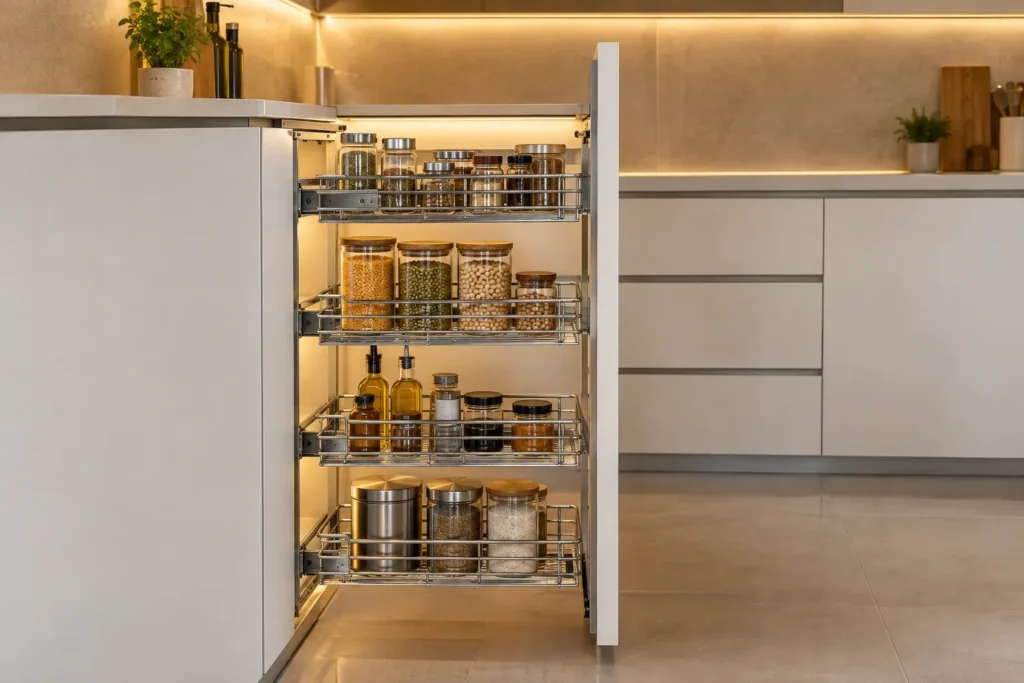
A kitchen trolley in a modular kitchen is not a single product. It is a category that covers pull-out baskets, pantry units, bottle pull-outs, corner solutions like the magic corner, and under-sink organisers. In Bangalore, a complete set of accessories for a medium 2BHK kitchen typically costs between ₹15,000 and ₹1,20,000, depending on the type, brand, and configuration. The right combination depends on your layout, your cooking habits, and what the inside of your cabinets actually does. Most homeowners finalising a modular kitchen get this decision wrong because they spend weeks picking the shutter finish and about ten minutes on what goes inside.
Key Takeaways:
- Every base cabinet in a modular kitchen needs a pull-out kitchen trolley with full-extension runners and soft-close. A fixed shelf in a 600mm-deep base unit is storage you will stop using within a month.
- SS 304 stainless steel outlasts SS 202 and chrome-finished mild steel in Bangalore kitchens. Cooking steam, monsoon humidity, and kitchens that face west or have no cross-ventilation are hard on cheaper basket grades.
- A magic corner unit recovers up to 70% of the dead space in an L-shaped or U-shaped corner cabinet. It costs ₹20,000 to ₹35,000 and is almost always the right call in a kitchen you are building to use for ten years.
- A pantry tall unit (₹18,000 to ₹65,000) solves the problem of the narrow column cabinet that everyone puts things in and never retrieves them from.
- Häfele and Hettich runners behave very differently from unbranded systems after two monsoons. Ask for the brand and rated load capacity in writing before approving any kitchen drawing.
Here is what happens in almost every kitchen consultation. The homeowner has spent three weeks comparing shutter finishes, two evenings choosing the countertop, and one long Sunday on the hob and chimney. Then the contractor points to a line on the quote that says “SS baskets with runners” and both parties move on.
Nobody asks which SS. Nobody asks which runners. Nobody asks whether the corner cabinet has anything inside it at all.
Six months after possession, the kitchen looks exactly as it did on day one. But the baskets are already stiff. The corner cabinet has a broken hinge and a masala dabba nobody can reach. The under-sink area is a pile of bottles with a mop leaning against it.
This guide is about that ten-minute conversation everyone skips. It covers every kitchen trolley type you will encounter when finalising a modular kitchen order, what each one actually costs in Bangalore, and how to tell a good accessory quote from a bad one before the cabinets go in.
What a Kitchen Trolley Actually Means in a Modular Kitchen
The phrase kitchen trolley means two completely different things depending on who is using it.
One is the freestanding cart on wheels that you pull out from under the counter or keep in a corner. Useful, particularly in kitchens that are short on counter space. Not what we are talking about here.
The other is a built-in pull-out storage mechanism that lives inside a modular cabinet and slides out when you open the door. This is what your contractor calls a “basket” or an “accessory.” It is also the part of a modular kitchen that most quotes describe vaguely and most homeowners approve without reading closely.
In a properly designed modular kitchen in Bangalore, every base cabinet should have some form of internal pull-out system. The reason is simple: a base cabinet is typically 600mm deep. Put a fixed shelf in there, and everything beyond the first 250mm disappears. You stop opening that cabinet within three weeks. The pull-out exists to bring the back of the cabinet to you.
The six types you will encounter most commonly:
- Pull-out baskets: the standard base unit solution
- Pantry tall units: full-height pull-outs for narrow column cabinets
- Bottle pull-outs: narrow vertical units for oils, sauces, and spices
- Magic corner or carousel units: corner cabinet solutions
- Under-sink organisers: cleaning supplies, waste bins, and pipe clearance
- Tandem drawer systems: the premium alternative to wire baskets
In Manish Jain’s experience working across Bangalore kitchens, the quote almost always says “SS baskets” and almost never specifies the grade, the runner brand, the extension depth, or the load capacity. That omission is the single biggest source of post-handover kitchen disappointment.
Pull-Out Baskets: What the Base Units Need
A pull-out kitchen trolley with full-extension runners is the minimum standard for any base unit in a well-built modular kitchen. Full-extension means the basket slides completely out of the cabinet. The full 600mm of depth becomes accessible. You can see everything, reach everything, and clean everything.
Partial-extension runners are cheaper. They leave 30 to 40mm of dead space at the back. After a year of daily cooking, that dead space has a life of its own.
Soft-close runners are not optional. They stop the basket from slamming into the back wall of the cabinet on the push-in. That matters for the runner mechanism and for the cabinet box itself. In Prestige and Brigade apartments in Bangalore, where kitchen footprints are compact and you are working in close proximity to all sides of the kitchen, a hard-slamming basket is something you notice on the first morning and resent by the first week.
Ask specifically: which brand are the runners, and what is the dynamic load rating? Häfele and Hettich both publish rated load data for their runner systems, typically 25 to 45 kg per pair. Unbranded runners from local fabricators carry no rated data. That matters when you are pulling out a basket loaded with steel thalis, a pressure cooker, and a kadai.
For the basket itself: wire baskets work for vegetables and lighter items because they ventilate. Stainless steel plate baskets hold heavy cookware and dishes properly. For daily Indian cooking, you need both: wire in the lower tier for onions and potatoes, solid plate baskets in the upper tier for vessels and lids.
Magic Corner vs. Carousel: The Corner Cabinet Decision
The corner cabinet is where most Indian kitchen layouts throw away storage without realising it.
A standard corner in a Bangalore apartment kitchen measures roughly 900mm x 900mm. Leave that corner as a plain cabinet with a fixed shelf, and the back 60% of it becomes a black hole. That is 0.25 square metres of floor area producing nothing. In a kitchen that is already 70 square feet or less, that loss is significant.
Two solutions exist: the carousel (Lazy Susan or D-carousel) and the magic corner.
A magic corner works like this. Open the cabinet door and pull the front handle out. The front basket slides out and the second basket, which was sitting deep in the corner, follows behind it. Both trays come into open space. Nothing is hidden. The mechanism recovers close to the full corner depth, which is why it costs more: ₹20,000 to ₹35,000.
A carousel spins on a central pole. It is cheaper at ₹8,000 to ₹20,000 and it does work. But the round shelves waste the triangular dead zones in a square corner cabinet. And heavy masala dabbas, steel handi sets, and large kadais do not sit well on a spinning circular shelf. Things slide, tip, and stack in ways that make retrieval worse than a fixed shelf would have been.
In Manish Jain’s view, the magic corner is the right choice in most L-shaped and U-shaped kitchens in Whitefield and Sarjapur Road apartment projects, where typical kitchen widths of 2.1m to 2.4m leave very little wasted corner space to accept. The carousel works as a cost compromise in kitchens where the corner is genuinely secondary storage for items used once a month.
One thing almost no guide mentions: a magic corner needs around 450mm of internal cabinet depth to operate correctly. In Brigade and Puravankara layouts, structural beams from the slab sometimes intrude into the back of the corner cabinet, reducing the internal depth to 400mm or less. If you have this constraint, confirm the internal dimension before specifying the mechanism. A magic corner fitted into 400mm of depth will bind and stick within six months of use.

Pantry Tall Units: The Narrow Column Problem
Every other apartment kitchen in Bangalore has one: a 300mm or 400mm column of cabinet space somewhere between the refrigerator and the wall, or between the chimney and the end of the counter run. The builder put it there. The contractor fitted a shutter to it. And now it holds six things you can reach and thirty things you have forgotten.
A pantry tall unit solves this. It is a full-height pull-out, typically 1800 to 2100mm, that sits inside a narrow column cabinet and slides out as a single unit when you open the door. Every shelf comes with you. Dal packets, rice, atta, spice jars, small appliances, whatever you store vertically. All of it is visible and reachable in one pull.
Basic pantry units start at ₹18,000. A premium Häfele system with soft-close full-extension runners, five to six basket tiers, and a rated load capacity goes up to ₹65,000. The difference is real. A basic unit feels adequate on the showroom floor and slightly wobbly under full grocery load. A Häfele unit with rated runners handles 30 to 40 kg without flex and pulls in and out smoothly well into the third or fourth year of daily use.
Talk to the Blue Interiors kitchen team before finalising your storage plan. Our team identifies the right pantry unit for your column width and cabinet height before the cabinet drawing is locked.
If your kitchen has a 300mm column gap anywhere in the layout, a pantry unit is almost certainly the most-used cabinet in your kitchen once it is fitted. The mistake is treating it as an afterthought accessory. It belongs in the first conversation about the kitchen layout, not the last.

Bottle Pull-Outs, Onion Baskets, and Under-Sink Units
These three get skipped more often than any other kitchen trolley type. They are also the three homeowners most commonly say they wish they had budgeted for.
A bottle pull-out is a narrow vertical unit, typically 150 to 200mm wide, designed to hold cooking oils, sauces, and tall spice bottles in an upright row. It fits in the filler column next to the hob or in a narrow gap that would otherwise be dead space. Pull it out and every bottle is visible and reachable. Cost: ₹2,500 to ₹9,000. If you cook Indian food daily, with four oils, a shelf of vinegars and chutneys, a row of masala bottles, this is more useful than any countertop spice rack.
An onion basket is ventilated wire on all sides. Onions, potatoes, and garlic need airflow to stay fresh. Put them in a sealed basket or on a closed shelf and you are trapping moisture. In a Bangalore kitchen during June to September, when humidity inside a closed kitchen regularly pushes past 80%, a sealed storage space means potatoes that sprout in ten days and onions that rot at the bottom before you reach them. Wire onion baskets with ventilation on all four sides cost ₹700 to ₹3,500 and belong in every kitchen where anyone stores root vegetables.
The under-sink cabinet is what contractors give the least thought to. They cut a hole for the pipe, fit a plain shelf, and move on. What that leaves you with is a dark, cramped space where a mop, three bottles of cleaning liquid, and a waste bin compete for floor area while the pipe runs through the middle. A dedicated under-sink organiser with a pull-out waste bin system and a separate shelf for cleaning supplies costs ₹2,500 to ₹12,000. In Bangalore apartments where the water purifier supply line also runs under the sink, getting this space properly organised is not aesthetic : it is about not having a pest issue by the second monsoon.

Which Material Actually Lasts in a Bangalore Kitchen
This is the question that almost never appears in the conversation between a homeowner and their contractor, and it is the question that determines what the inside of the kitchen looks like in year three.
SS 304 stainless steel is the right material for wet-zone baskets, under-sink units, and anything near the hob. It resists corrosion well in humid environments because of its higher chromium and nickel content. In kitchens with poor cross-ventilation, which covers most west-facing 2BHK kitchens in Electronic City, Hebbal, and interior-facing apartments in Koramangala, SS 304 is the only basket grade that holds up without rust spotting. It costs 30 to 50% more than lower-grade options. Worth it.
SS 202 is acceptable for upper cabinets and dry storage zones. In a dry-zone context, it performs well enough. Put it near the sink or under the hob and it will start showing rust at the weld joints within three to four years. Not a failure of the product. Just the wrong grade in the wrong position.
Chrome-finished mild steel is what goes into most budget kitchen quotes without being identified as such. It looks clean and bright at handover. After two monsoons in a Bangalore kitchen with a single exhaust fan and no windows that open wide enough to matter, the chrome begins peeling at the basket edges. Rust follows at the welds. This is predictable. It is not a defect claim you can make against your contractor. It is a natural outcome of specifying mild steel in a humid cooking environment.
Wire baskets come in both SS and mild steel. The material is not obvious from looking at them. Ask before approving. A mild steel wire basket in an under-sink position will rust at the weld points in 18 to 24 months regardless of how dry you try to keep it.
As a Häfele Studio Partner, Blue Interiors specifies Häfele kitchen hardware for all kitchen projects. The runners, baskets, and mechanisms carry consistent load ratings — and for Hettich Cargo wire products, that includes a 10-year replacement warranty against rust backed by manufacturing at their Vadodara plant.

Price Guide: What Each Type Costs in Bangalore (2026)
| Trolley Type | Price Range | Notes |
| Wire pull-out basket | ₹900 to ₹3,000 | Check grade. Mild steel with chrome is the default in most contractor quotes |
| SS pull-out basket | ₹2,500 to ₹8,000 | Specify SS 304 for base units and wet zones |
| Bottle pull-out | ₹2,500 to ₹9,000 | Fits in narrow filler column next to hob |
| Onion basket | ₹700 to ₹3,500 | Ventilated wire; do not substitute with a sealed basket |
| Basic pantry tall unit | ₹18,000 to ₹30,000 | Standard soft-close; 4 to 5 basket system |
| Premium pantry unit (Häfele) | ₹35,000 to ₹65,000 | Rated load capacity; handles daily grocery weight over years |
| Carousel / D-Lazy Susan | ₹8,000 to ₹20,000 | Cheaper; round shelves waste triangular corner space |
| Magic corner unit | ₹20,000 to ₹35,000 | Best corner recovery; needs 450mm internal cabinet depth |
| Under-sink basket | ₹2,000 to ₹5,000 | Fixed-frame option for pipe-clearance zones |
| Waste bin pull-out (single or dual) | ₹2,500 to ₹12,000 | Integrates into under-sink cabinet door opening |
| Tandem drawer system | ₹6,000 to ₹15,000 | Solid-sided; better than wire baskets for cookware and plates |
A standard accessory package for a medium 2BHK Bangalore kitchen (SS baskets, bottle pull-out, grain drawer, under-sink unit, and a corner solution) runs ₹15,000 to ₹35,000 above the cabinet structure cost. A premium package with a Häfele pantry unit, magic corner, and SS 304 tandem drawers runs ₹45,000 to ₹1,20,000.
Prices reflect Bangalore market rates in 2026. Final cost varies by cabinet count, hardware brand, and whether sizing is standard or custom.
What to Ask Before You Sign Off on the Kitchen Drawing
Most kitchen quotations in Bangalore list accessories as a single line item. “SS baskets with runners” is the full description in about 80% of the quotes homeowners bring to the Blue Interiors office for a second opinion. Here is what that line is not telling you.
Ask for the runner brand and the dynamic load rating. No brand and no rated capacity means unbranded runners with no performance benchmark. They sag and stiffen within two years of daily loading. Ask specifically for Häfele or Hettich and ask for the rated capacity in kilograms.
Ask whether the runners are full-extension or partial-extension. This distinction belongs in the quote. If it is not there, the runners are probably partial-extension. Ask for full-extension in writing.
Ask for the basket material and grade. SS 304 and SS 202 are both “stainless steel.” They are not the same material in a cooking environment. Ask which grade, ask for it in writing, and check the quote before it goes to a fabricator.
Ask what is inside the corner cabinet. Show the kitchen drawing to three contractors and most will have the corner marked as a plain box with no accessory specified. Ask what goes in there. If the answer is a fixed shelf, that is dead storage.
Ask whether soft-close is included for the pull-outs, not just the shutters. Soft-close shutters and soft-close runners for pull-out trolleys are separate components. Both need to be specified. One without the other is a gap.
Ask for basket dimensions versus internal cabinet opening. A basket sized for a standard 800mm opening will not fit correctly in a 780mm opening after the cabinet liner is fitted. Sizing should be confirmed against the actual internal measurement of each cabinet, not pulled from a catalogue.
Manish Jain notes that homeowners who bring these questions to a contractor before approving the drawing almost always get a better outcome, simply because the contractor understands the standard is higher. Get the answers in writing. The time to change accessory specifications is before fabrication starts, not after the kitchen is delivered.
Frequently Asked Questions
Which kitchen trolley is best for Indian cooking?
For Indian cooking, the most practical combination is SS 304 pull-out baskets in base units, a bottle pull-out near the hob for oils and spices, and a ventilated wire onion basket for root vegetables. Indian kitchens produce more steam, oil vapour, and heavy cookware loads than most European kitchens are designed around. SS 304 hardware with rated runners is the appropriate specification. Chrome or SS 202 will fall short within a few years.
What is the standard size of a modular kitchen trolley?
Pull-out baskets in Indian modular kitchens are typically sized for cabinet openings that range from 400mm to 900mm wide, with depths matched to the standard 600mm cabinet interior. Standard catalogue sizes exist, but basket dimensions should always be confirmed against the actual internal measurement of each cabinet before the order goes out. An 800mm basket in a 780mm opening will bind on the sides.
How much does a magic corner cost in India?
A magic corner unit in India costs between ₹20,000 and ₹35,000 depending on brand, basket size, and mechanism. Häfele and Hettich units at the higher end come with rated load capacities and better finish durability than generic alternatives. A carousel costs ₹8,000 to ₹20,000 but recovers less corner space and handles heavy Indian cookware poorly on its round rotating shelves.
Can I add trolleys to my existing kitchen if I did not include them when building it?
Yes, partially. Slide-in readymade kitchen trolley units are available for ₹1,500 to ₹6,000 and can go into existing base cabinets without major modification. The limitation is fit: readymade units come in standard sizes, so the basket may sit loose in the cabinet. A custom-built pull-out sized to your specific cabinet opening always fits better. Under-sink organisers and waste bin pull-outs can usually be retrofitted without touching the cabinet structure.
What is the difference between SS 202 and SS 304 for kitchen baskets?
SS 304 has higher chromium and nickel content than SS 202, which makes it significantly more resistant to corrosion and rust spotting in humid environments. In a Bangalore kitchen with limited ventilation or a west-facing exposure, SS 304 baskets in wet zones will hold up three to five years longer than SS 202 before showing rust. The price difference is 20 to 40%. For base units and under-sink areas, SS 304 is the correct specification.
Conclusion
The kitchen trolley decision is not a detail to settle at the end of the drawing approval. It shapes how the kitchen works every single day. The difference between full-extension SS 304 pull-outs with Häfele runners and a magic corner, versus partial-extension chrome baskets with a fixed corner shelf, is not visible when you walk into the showroom. You feel it the morning after possession. And you feel it for the next ten years.
Get the accessory list specified properly. Check the grade, the runner brand, the extension type, and the corner solution. Do not sign off on “SS baskets with runners” without knowing what those words mean on your contractor’s quote. The questions are not complicated. The answers just need to be asked.
Get the Accessory Decision Right the First Time
Choosing trolley systems after the cabinet drawing is finalised always involves compromises. Cabinet widths are already locked. Magic corner depth may no longer be achievable. The pantry column is gone. The conversation about accessories belongs in the first kitchen planning session, not the last.
Blue Interiors is a Häfele Studio Partner. The hardware we specify carries rated load data, finish warranties, and consistent manufacturing quality across every mechanism. Paired with BWP 710-grade plywood cabinet boxes and a 10-Year Warranty on interiors, the kitchens we build work the same way inside the cabinet as they look from the outside.
- Book a free kitchen consultation
- See completed kitchen projects
- Call or WhatsApp: +91-8123387210 | +91-8618380923 (10 AM to 8 PM)
For a full understanding of what goes into planning a modular kitchen in Bangalore, including layout decisions, costs, and what to ask before you start, read the complete modular kitchen guide for Bangalore homeowners.
About the Author
Manish Jain | Founder & Creative Director, Blue Interiors
Manish Jain is the Founder and Creative Director of Blue Interiors, a premium residential interior design firm based in Bangalore. With 15 years of experience across luxury home interiors, modular kitchens, and turnkey solutions for urban Indian homes, Manish has guided thousands of homeowners through the full design and execution process. His work spans compact 2BHK apartments to premium villas across Bangalore, with a consistent focus on quality materials, practical space planning, and design that fits the way people actually live.