
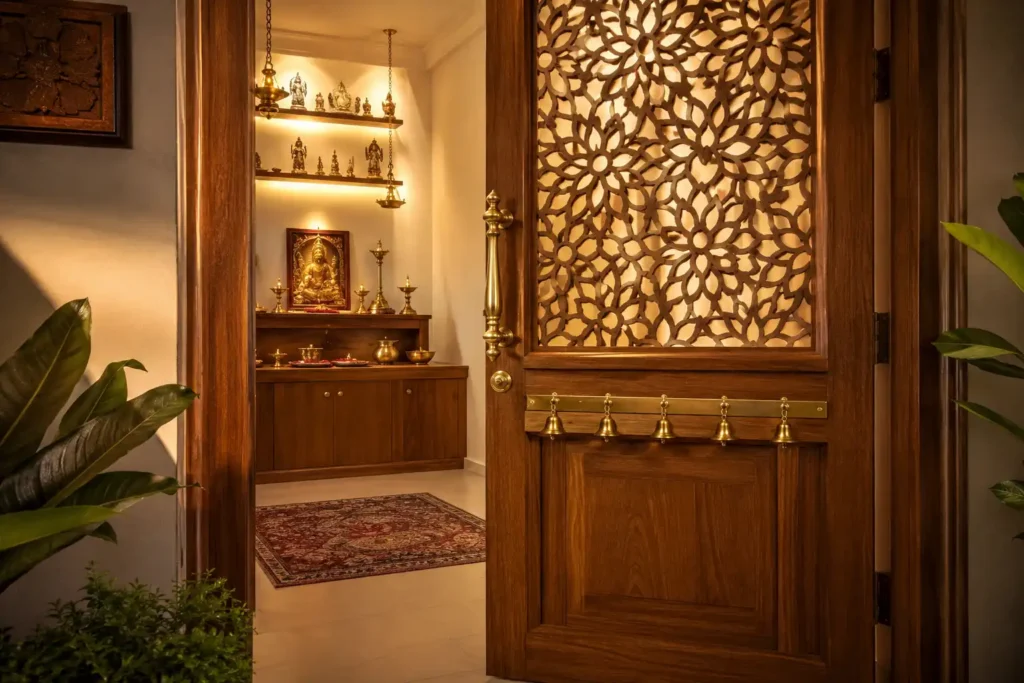
Quick Answer: A pooja room door cnc design adds machine cut jali patterns or embedded bells onto a wood, glass, or MDF pooja door you have already chosen. It is ornamentation, not a door type. Choose the pattern based on airflow needs, wall context, and whether you want the door to sound bells on entry. Teak and Sheesham hold detail best in Bangalore’s humidity, while MDF is the cheapest option but needs sealed edges before cutting, not after.
Key Takeaways:
- CNC work and bells sit on top of a door you have already chosen, they are not a door type on their own
- Match jali density to wall context, plain walls carry busier patterns better than tiled or patterned walls
- Material under the cut matters more than the pattern for long term durability in Bangalore humidity
- Bell placement should follow the door’s swing arc, not sit centred purely for symmetry
- Get itemised pricing from Blue Interiors before committing to a material and pattern combination
What Is a Pooja Room Door CNC Design?
A pooja room door cnc design is a customisation layer, not a door type. You take a solid, glass, or wood pooja door and add machine cut jali patterns or embedded temple bells on top of it. The pattern you choose depends on three things: how much airflow the alcove needs, whether the room faces a busy hallway, and whether you want the door to make sound when opened.
CNC cutting is precise and repeatable, but the frame material underneath still decides how long the design lasts. I have designed CNC jali and bell doors for close to a decade of Bangalore projects, and the question I get most is not which pattern looks nicest. It is whether it will survive the monsoon and still look sharp in five years. That is the part most galleries skip, so it is where I am starting.
If you have already picked a wood or glass door and just want the ornamentation sorted, keep reading. If not, our guide to pooja room door designs in wood and our modern pooja room glass door designs post cover that decision first.
What Are the 7 Most Popular Pooja Room Door CNC Design Patterns?
These are the patterns Bangalore clients ask for most, roughly in order of demand.
1. Geometric Grid Jali Repeating squares or diamonds cut in a uniform grid. Works best against a plain wall, since a busy tile background plus a dense grid starts to look cluttered fast.
2. Floral Trellis Curved, vine like cuts that pair well with teak or Sheesham frames. Needs a slightly thicker panel, around 18 to 19mm, because curved cuts are more delicate than straight lines.
3. Om and Kalash Symbol Panel A single religious motif as the centrepiece with a plain or lightly patterned border. Works better as one focal cut than repeated across the whole door.
4. Lotus Motif Cutwork Layered lotus petals cut in graduated depth. A popular choice for families who want a softer, less geometric look than a grid.
5. Mandala Centre Panel A circular, symmetrical pattern usually reserved for larger double doors where there is enough surface to let the detail breathe.
6. Partial Upper Panel Jali Only the top third of the door is cut, keeping the lower two thirds solid for strength near the hinges. This is what we used in the Whitefield project further below.
7. Bell Door Design Brass or bronze bells mounted at the top rail or handle rail, covered in detail in the next section.

The pattern you pick should match your wall, not just your taste. A dense mandala against a patterned floor tile fights for attention. A plain grid against a plain wall reads as intentional instead of busy.
Get a Design Match for Your Space
Send us a photo of your pooja alcove and we will tell you honestly which of these seven patterns actually fits before you commit to a cut. Book your free consultation
How Much Does a Pooja Room Door CNC Design Cost in India?
Cost depends almost entirely on the base material, not the pattern complexity.
| Material | CNC Suitability | Bangalore Climate Fit | Cost per sq ft |
| Teak | Excellent, holds fine detail | Very good, naturally moisture resistant | ₹950 to ₹1,400 |
| Sheesham | Good | Good | ₹700 to ₹1,000 |
| MDF (moisture resistant grade) | Excellent, cheapest for intricate cuts | Needs sealed edges | ₹350 to ₹550 |
| MR Plywood | Good | Good with edge banding | ₹500 to ₹750 |
Confirm current rates with Blue Interiors before budgeting. Fabricator pricing shifts by season and cut density, so treat this table as a starting reference rather than a quote.

Where Should Bells Be Placed on a Pooja Room Bell Door Design?
Pooja room bell door designs embed small brass or bronze bells so the door produces sound when opened, the same instinct behind a temple entrance bell. This is not purely decorative. Several families I have worked with specifically wanted an audible cue when someone entered the pooja room.
Mount position matters more than bell count. A bell placed too close to the hinge barely moves and stays silent. It needs to sit roughly a third of the way in from the outer door edge, along the actual swing arc, so it strikes a fixed plate every time the door moves.

How Does Pooja Room Design Cement Work Fit In?
Pooja room design cement work gets confused with CNC cutting often, but they solve different problems. Cement or plaster relief work is applied to the alcove frame or wall niche, not the door leaf itself. If your contractor is proposing a cement archway or jharokha style frame, the CNC door sits inside that frame as a separate decision. Do not let one vendor’s cement estimate double as your door budget. They are usually quoted and executed separately.
Which Material Holds Up Best Under CNC Cutting?
Teak holds fine detail well and resists Bangalore’s humidity without much intervention. Sheesham is close behind but slightly harder to cut for very fine lines. MDF is the cheapest option for intricate cuts, but the exposed edges inside every cut gap need sealing before installation, not after.
Expert Tip from Manish Jain: On MDF jali panels, I always insist on a sealed edge coat before the CNC cut, not after. Cutting first and sealing later leaves every exposed inner edge untreated, and in Bangalore’s humidity that is exactly where swelling starts.

What Does a Real Pooja Room Door CNC Design Project Look Like?
A Whitefield client came to us with a teak pooja door frame already installed by their carpenter, wanting CNC jali added without replacing the door. We ran a floral trellis pattern across the upper third only, keeping the lower two thirds solid for structural strength near the hinges. Bells were added at the handle rail, positioned along the swing arc rather than centred, so they actually rang on use. The family’s main request, letting incense smoke escape without leaving the door open, was solved by the trellis panel alone.

Not sure which base door suits your alcove before adding CNC work? Our 9 pooja room door styles guide and Pooja Room Vastu Shastra guide cover placement rules that affect which pattern will actually work for your space.
How Do You Maintain a CNC Jali or Bell Door?
Fine cuts collect dust in the gaps faster than a flat panel does, which is the trade off for the airflow benefit. A soft bristle brush weekly, and a damp, not wet, cloth wipe monthly, keeps detail crisp without pushing moisture into cut edges.
Expert Tip from Manish Jain: Avoid direct wet mopping near the base of jali panels during monsoon months. Standing water at the threshold can wick into exposed cut grain over time, even on sealed MDF.
For modern pooja room door designs with heavy ornamentation, this small habit adds years to how sharp the pattern stays.
Ornamental detailing like lattice and carved work has consistently ranked as a requested feature in Indian home renovations, according to the Houzz India Renovation Trends Study, which tracks with what we see in pooja room briefs specifically. The broader shift toward customised, craftsmanship-led interior elements is also reflected in the Mordor Intelligence India interior design market report, if you want the wider category picture beyond pooja rooms.

Frequently Asked Questions
Can CNC jali doors be used with glass pooja room doors?
Yes. CNC cut wood panels are often paired with frosted or stained glass inserts behind the jali cutouts. This combination adds a soft glow effect once lit from inside the alcove. It is covered in more depth in our modern glass door designs post.
Do CNC cut pooja doors need more maintenance than solid doors?
Slightly, yes. The cut gaps collect dust faster and need a weekly soft brush pass. In exchange, they let smoke and heat escape, which a solid panel does not allow at all.
Is a CNC pooja door a good fit for small apartments?
Yes, especially partial upper panel jali or slim geometric grids. These patterns keep the door visually light without shrinking usable alcove space, which matters most in compact Bangalore apartments.
What is the real difference between MDF and solid wood for CNC jali?
MDF is cheaper and takes intricate detail well, but needs sealed edges before cutting. Solid wood like teak costs more upfront but resists humidity naturally, so it needs less ongoing edge maintenance.
How long does a CNC pooja door installation take?
A straightforward panel typically takes one to two weeks from final pattern approval to installation, depending on material availability and fabricator backlog. Complex double door mandala work can take longer.
Ready to Design Your Pooja Room Door?
Bring us your door frame dimensions and we will map out a CNC and bell layout that fits your space, budget, and Bangalore’s climate before a single cut is made. Book your free door design consultation and see the pattern first, not after.
Not sure which service track fits your project? See our full interior design services for turnkey and modular options.
Author Bio
Manish Jain is the Founder and Creative Director of Blue Interiors, with over 15 years designing residential and commercial interiors across Bangalore. He has personally reviewed hundreds of pooja room briefs, from single panel apartment alcoves to full jharokha style mandir setups. Get in touch with Blue Interiors for a door design consultation.