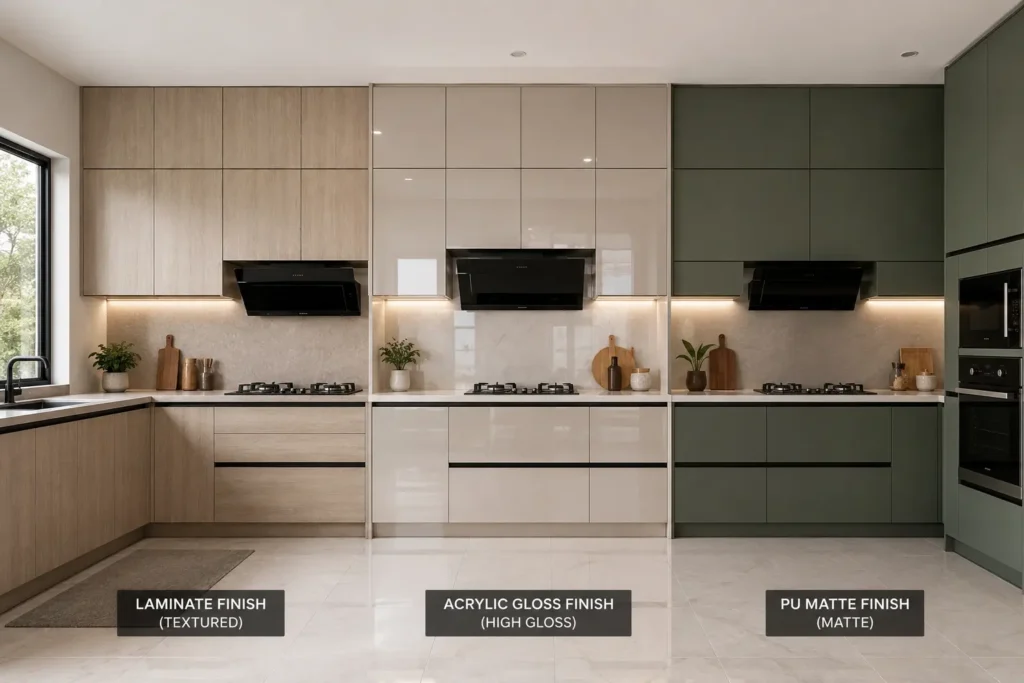
Here’s something most vendors won’t tell you upfront: nearly 40% of modular kitchen shutters in Bangalore homes show visible wear within three years. Not because the design was bad. Usually it’s because the modular kitchen shutter materials India buyers picked never matched how the family actually cooks.
If you’ve already locked in your kitchen layout and now you’re stuck flipping through vendor quotes trying to figure out which shutter finish is right, you’re in good company. Every dealer swears by a different material, and the sample piece they hand you across a showroom counter tells you nothing about how that finish holds up after two monsoons and a hundred tadka sessions.
This guide walks through how laminate, acrylic, PU, membrane, glass, and metal or cane finishes actually behave once installed in a working Bangalore kitchen, not a display unit. You’ll know which one suits your cooking style and budget, and how to avoid picking a finish you’ll regret in 18 months.
Manish Jain, Founder and Creative Director of Blue Interiors, has been specifying shutter materials for luxury residential kitchens across Bangalore for over 15 years. He’s seen which finishes age gracefully and which ones start peeling the moment the honeymoon phase ends.
1. What Are the Main Modular Kitchen Shutter Materials Used in India?
Modular kitchen shutter materials are the surface finishes bonded onto MDF or plywood cabinet doors. Common types are laminate, acrylic, PU paint, PVC membrane, veneer, glass, and metal or cane. Laminate, acrylic, PU, and veneer together account for most installations, while glass, metal, and cane are used mainly as accents.
Walk into any modular kitchen showroom in Bangalore and you’ll be shown roughly the same seven materials, just dressed up differently depending on who’s selling. The layer bonded onto the base board is what takes the daily beating, so it’s really what you’re buying when you choose a finish.
Four of these, laminate, acrylic, PU, and veneer, cover about 90% of what actually gets installed in Indian homes. Glass, metal, and cane look fantastic in patches, but almost nobody uses them across an entire kitchen, and for good reason, which we’ll get into further down.

2. Laminate vs Acrylic Kitchen Shutters India: Which Holds Up Better?
Laminate is a resin sheet pressed onto MDF, valued for scratch and stain resistance on high traffic cabinets. Acrylic is a glossy sheet bonded to MDF for a mirror like finish, better suited to low use display units than daily cooking zones.
This is the comparison almost every client brings up in the first meeting, and it’s the right question to ask.
Laminate shrugs off scratches and stains reasonably well thanks to that hard outer layer, which is exactly why it ends up on base cabinets that take the most daily abuse. Acrylic gives you that mirror-like, showroom finish. It looks incredible in photos. It looks less incredible three weeks in, once fingerprints start showing.
| Factor | Laminate | Acrylic |
| Look | Matte to gloss, wide range | High gloss, premium |
| Fingerprint visibility | Low | High |
| Cost per sq ft | Moderate | Higher |
| Best for | Daily heavy cooking | Low cooking display kitchens |
| Lifespan (well maintained) | 10 to 12 years | 8 to 10 years |
Expert tip from Manish Jain: Almost every laminate vs acrylic kitchen shutters India conversation I have with Bangalore clients who cook daily ends the same way. I push them toward laminate on the base cabinets and save acrylic for the upper display units only. It’s rarely about picking one over the other. It’s about knowing where each one belongs.
Not sure which combination actually fits your kitchen? Talk to Blue Interiors and book a Materials Showroom Visit so you can see both finishes side by side before committing to anything.
3. Which Kitchen Shutter Material Is Best for Bangalore Humidity?
For Bangalore humidity, the substrate matters more than the finish on top. BWP plywood or HDHMR core, paired with laminate or acrylic facing, resists edge swelling far better than a weaker MDF core under any premium surface.
Bangalore doesn’t get as brutal as coastal cities, but don’t let that fool you. Humidity swings during monsoon still quietly work away at shutter substrates and edge bonding, even if you don’t notice it until year three.
Why the substrate matters more than the finish A gorgeous acrylic shutter sitting on a cheap MDF core will still swell at the edges the first time humidity spikes. Always ask about carcass and substrate grade before you even start discussing finish. This is exactly where most vendor pitches fall apart, because they only ever show you the surface sample, never the board underneath it.
Edge banding is the part nobody checks Most shutter failures in Bangalore kitchens don’t start on the face of the cabinet. They start at the edge band. Ask your vendor directly about PVC edge banding thickness, somewhere between 0.8mm and 2mm is what you want, no matter which finish you eventually pick.
For a full breakdown of layouts and materials suited to Bangalore homes, take a look at our [Modular Kitchen Design in Bangalore: The Complete Guide (2026).]
Real project reference: We had a client in HSR Layout recently who’d already shortlisted acrylic purely because it looked stunning in the showroom. Once we understood how much they actually cooked, and how their kitchen ventilation was set up, we recommended a laminate and acrylic hybrid instead, laminate on the base units, acrylic just on the island. They got the premium look they wanted without the maintenance headache of full acrylic.

4. PU Finish vs Membrane Finish for Modular Kitchen India: Which Lasts Longer?
PU finish is a sprayed, cured polyurethane coating offering seamless colour matching and strong heat resistance. Membrane finish is a PVC foil vacuum pressed onto routed MDF, cheaper upfront but prone to peeling near heat within 5 to 8 years.
This comes up almost as often as laminate versus acrylic, and it’s where the gap between a good vendor and a cheap one becomes obvious pretty fast.
PU gives you a smooth, precisely colour matched layer that resists yellowing over time, which is why it’s the go to for custom colour, handle less kitchens. Membrane is cheaper and lets you get 3D profiles, but it doesn’t handle heat nearly as well.
In most PU finish vs membrane finish for modular kitchen India debates we’ve walked clients through, PU wins on longevity in visible zones simply because it doesn’t peel. You’re not paying for recoating down the line the way you sometimes do with membranes.
Comparing all four finishes side by side
| Finish | Heat resistance | Typical lifespan | Cost per sq ft (approx.) |
| PU | High | 10 to 15 years | High |
| Membrane | Low | 5 to 8 years | Low to moderate |
| Glass | Moderate | 10 to 12 years (frame dependent) | High |
| Metal | High | 12 to 15 years | High |
According to the Mordor Intelligence India Interior Design Market report, rising demand for low maintenance, moisture resistant surfaces is one of the key trends reshaping material choices in the Indian residential interiors segment, a shift that lines up with what we see firsthand in Bangalore kitchens where PU and laminate are steadily replacing membrane in cooking zones.
The Houzz India Renovation Trends Study adds another layer to this. Homeowners across Indian metros are now leaning toward decisions driven by long term maintenance rather than upfront price alone. That tracks exactly with what we’re seeing in our own Bangalore consultations, where clients ask about lifespan before they even get to the pricing conversation.

5. Glass Shutters: Worth It for an Indian Kitchen?
Glass shutters use tempered or lacquered glass set into an aluminium or wooden frame. They work by reflecting or transmitting light depending on the glass type, and are most commonly used on wall units to display crockery, not on base cabinets near heat or oil.
Vendors rarely push glass on you, mostly because the margins are thinner. But glass solves a very specific problem that laminate and acrylic simply can’t.
It looks genuinely striking in a well lit kitchen. But let’s be honest about the downside too. Glass on base cabinets or anywhere near the cooktop is a bad idea. Oil residue shows up on glass almost instantly, far faster than on laminate, and wiping it down every day gets old quickly. In our own Bangalore projects, glass earns its place on two or three wall units in the dry zone. We don’t recommend it as the primary material across an entire kitchen, and we tell clients this even when they’re excited about the look.
Curious whether glass shutters would work in your layout? Explore our full range of interior design services to see how we approach material selection for every room, then reach out through our contact page to discuss your specific kitchen.
6. Metal and Cane Shutters: Where They Actually Work
Metal shutters use brushed steel or aluminium over an MDF base for an industrial look, usually on a single feature unit. Cane shutters use rattan weave in a wooden frame for warmth and texture, typically used in open shelving away from heat and oil.
Metal and cane aren’t mainstream choices by any stretch, but over the last couple of years they’ve quietly become the go to accent materials in contemporary Bangalore kitchens.
Metal brings a stripped back look that laminate or acrylic just can’t fake, which is why it usually shows up on a single feature wall unit or a pantry front rather than an entire kitchen. Cane takes a completely different route, adding warmth and pairing beautifully with wood finish carcasses. You’ll typically see cane on open shelving or crockery units, never near the stove, since it has zero tolerance for oil or heat.
Both cost more per square foot than laminate once sourced properly, and both genuinely need a fabricator who has actually worked with these materials before, not someone learning in your kitchen. Ask to see a completed project in person, not just a sample swatch, before you say yes to either one.
7. How Much Does Shutter Material Add to Your Modular Kitchen Cost?
Shutter material typically adds 15 to 30% to total kitchen cost, priced per square foot rather than per unit. Laminate sits at the lower end, membrane just above it, and PU, acrylic, glass, and metal accents sit toward the higher end.
Shutter finish is one of the biggest cost swings in any modular kitchen quote, and honestly, it’s also where a lot of vendors quietly bury their margin.
The IMARC Group India Interior Design Market report notes that rising disposable incomes and growing preference for premium finishes are driving up average spend on modular kitchen materials across urban India, a trend reflected directly in the wider price gap we now see between laminate and premium finishes like PU or acrylic and glass.
For a full layout wise breakdown, our [Modular Kitchen Cost in Bangalore] guide walks through exactly how shutter choice shifts your final number across L shape, U shape, and island layouts.
Still juggling quotes from three different vendors and not sure which numbers actually make sense? A quick conversation with our design team can save you from paying premium prices for a finish your kitchen doesn’t even need. Get in touch with Blue Interiors before you sign anything.
8. Which Shutter Material Needs the Least Maintenance?
Laminate needs the least maintenance among common modular kitchen shutter materials. It resists staining without polishing or recoating and is most commonly chosen by families with high daily cooking frequency.
If you cook every single day, maintenance ease matters a lot more than how the cabinet looks under showroom lighting.
Matte laminate specifically hides fingerprints and light scratches far better than any gloss finish, and that’s really why it remains the most installed shutter material across Bangalore’s mid to premium kitchen segment. If you’re also thinking about better internal organisation, our [Modular Kitchen Storage Fittings] guide covers pull outs, baskets, and corner units that work well alongside laminate cabinets.

Trust and Authority
“The shutter finish a client falls in love with in a showroom is rarely the one that survives their actual kitchen habits. My job is to match the finish to how they cook, not how the sample looks under gallery lighting.” Manish Jain, Founder and Creative Director, Blue Interiors, 2026
Fifteen plus years designing kitchens across HSR Layout, Whitefield, Koramangala, Sarjapur, and Indiranagar has taught us one thing consistently. Clients who base their shutter choice on substrate quality and actual cooking habits, not just how glossy something looks, end up complaining a lot less two or three years down the line.
FAQs
1. Which is better, laminate or acrylic for a modular kitchen?
Laminate holds up better for daily heavy cooking and hides fingerprints far more effectively. Acrylic gives you a glossier, more premium look but shows scratches and smudges quickly, so it works best on low use display units.
2. Which shutter material is best for an Indian kitchen?
For most Indian kitchens dealing with regular oil based cooking, laminate on a BWP plywood or HDHMR substrate gives you the best mix of durability, cost, and maintenance.
3. What is the difference between PU and membrane finish?
PU is a sprayed, cured coating that gives seamless colour matching and better heat resistance. Membrane is a PVC foil pressed onto routed MDF, cheaper upfront but prone to peeling near heat sources within 5 to 8 years.
4. Is an acrylic kitchen shutter good for a humid climate?
It performs reasonably well in humidity, but only when bonded to a moisture resistant substrate like BWP plywood. The core board quality actually matters more than the acrylic surface itself.
5. How long do modular kitchen shutters last?
Laminate typically runs 10 to 12 years, acrylic 8 to 10 years, and membrane 5 to 8 years, depending on substrate quality, edge banding, and how close the shutters sit to heat sources.
Conclusion
Choosing the right modular kitchen shutter materials India offers really comes down to three things: how much you cook, how good your substrate is, and how much maintenance you’re genuinely willing to do. Laminate wins on durability and low maintenance. Acrylic wins on looks for display zones. Glass and metal only earn their place as accents, not as your primary material. PU and membrane each fit specific budgets and customisation needs. Get the substrate sorted first, because the finish on top only performs as well as what’s holding it up.
Ready to Choose a Finish That Actually Lasts?
Stop guessing based on showroom lighting and vendor promises. The finish that looks perfect under gallery spotlights isn’t always the one that survives your actual kitchen. Talk to Manish Jain and the Blue Interiors team, bring your layout, your budget, and your cooking habits, and walk away with a shutter material decision you won’t second guess in two years. Get in touch with Blue Interiors today and let’s sort this out properly.
Author Bio: Manish Jain is the Founder and Creative Director of Blue Interiors, with 15 plus years of excellence in luxury residential and commercial interiors across Bangalore. He has personally specified kitchen materials for projects across HSR Layout, Whitefield, Koramangala, and Sarjapur.