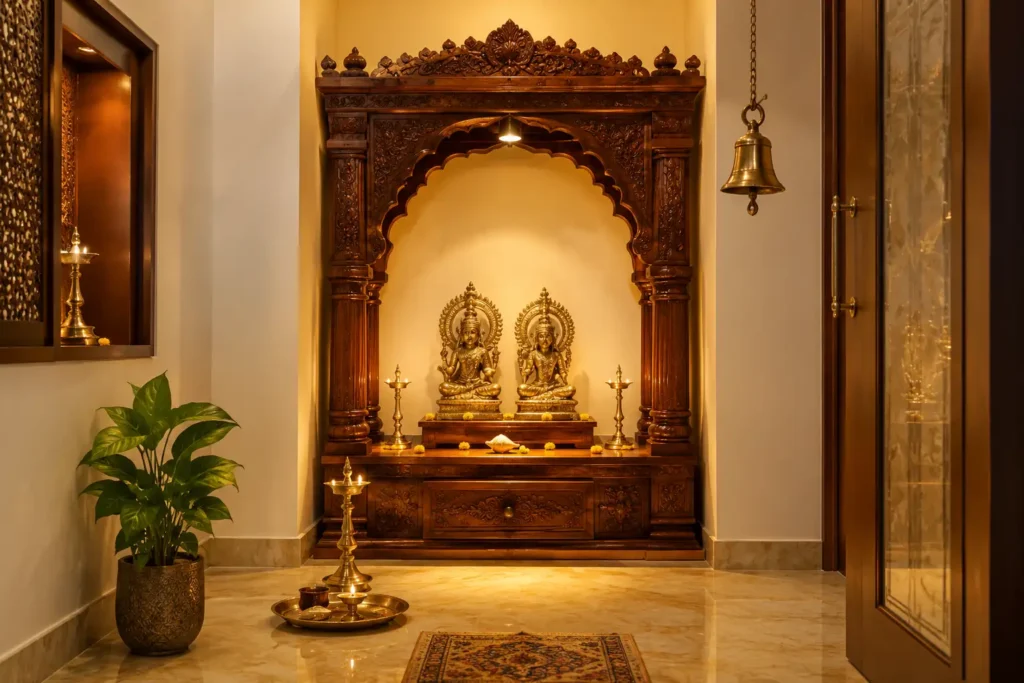
Quick Answer: Good indian style pooja room designs really come down to three things, a wooden mandir frame, a Northeast facing layout, and warm lighting instead of a harsh spotlight aimed straight at the idols. You can get this look in a full room, a wall alcove, or a small cabinet mandir. It depends on how much space your home is actually willing to give up, and most homes give up less than people hope.
Key Takeaways:
- Teak and sheesham hold up best in humid cities. Wood is what makes a mandir read as traditional, not the size of the room built around it.
- You do not need a full room. An alcove or a cabinet mandir gets you the same traditional look in a fraction of the space, and sometimes it looks better for it.
- The Northeast corner is the standard Vastu placement, but there are workarounds when your flat’s layout simply does not cooperate.
- Lighting decides whether the space feels devotional or looks like a supply shelf. Warm, angled light, never a spotlight pointed straight at the idols.
- Budgets for pooja room mandir designs in 2026 typically sit between ₹35,000 and ₹2,00,000, mostly depending on material and size.
I have sat through this same conversation more times than I can count. A client walks in, phone out, showing me a photo of their grandmother’s pooja room from some old family album, and says, more or less, “I want it to feel like this.” Not a showroom. Not something from a catalogue shoot. Something with weight to it. That, stripped of all the marketing language, is what indian style pooja room designs are actually chasing. Wood over marble laminate. Warm brass over anything that looks like gold paint. A corner that feels like it has been prayed in, not staged the morning before handover photos.
Most people pick the mandir first and figure out the room around it second. I get why, the mandir is the exciting part. But it is backwards, and I say this after watching more than one client redo their choice halfway through a project. Sort the direction and the material out first. Everything that comes after gets easier once those two decisions are locked.
Here is what this guide actually covers, nine design ideas worth looking at, the materials that hold up in Bangalore’s particular brand of humidity, and where to put the mandir when your apartment refuses to give you a Northeast corner on a plate. Manish Jain, Founder and Creative Director at Blue Interiors, has spent 15 plus years designing luxury residential and commercial interiors across Bangalore, and has personally sat with pooja spaces ranging from a single wall alcove in a 2BHK to a full mandir room in an independent villa.
What Are the Best Indian Style Pooja Room Designs?
There genuinely is no single right answer here, and I say that even though clients ask me to just pick one for them fairly often. It depends on your space, your budget, and honestly, how much carved detail you are willing to dust every week for the next couple of decades. These are the 9 styles we get asked for most, roughly in the order people tend to land on once they have seen all nine side by side and stopped arguing with themselves.
The most common indian style pooja room designs are wood frame mandirs, marble platform mandirs, wall alcove mandirs, jaali lattice mandirs, cabinet mandirs, corner shelf mandirs, glass and wood combination mandirs, CNC cut panel mandirs, and minimalist white mandirs.
- Teak wood arched mandir with a carved crown, about as close as you get to a classic South Indian temple look in a home.
- Marble platform mandir, cool underfoot, easy to wipe down, works nicely in a larger room.
- Wall alcove mandir, recessed into the wall so it does not steal an inch of floor space.
- Jaali lattice mandir, a carved lattice door that lets incense smoke drift out instead of sitting trapped in the room.
- Cabinet mandir, freestanding, portable, the sensible pick if you are renting and might move in two years.
- Corner shelf mandir, a plain wooden shelf tucked into a corner that was doing nothing before this.
- Glass and wood mandir, glass shelving set inside a wooden frame, common in newer apartment builds.
- CNC cut panel mandir, machine carved motifs at a fraction of hand carving cost, and truthfully hard to spot the difference from across the room.
- Minimalist white mandir, clean lines, a little brass here and there, for homes that want the tradition without the visual noise.

If your apartment is on the smaller side, our small pooja room designs for apartments piece goes deeper into styles 3, 5 and 6 above.
Still torn between two or three of these? Book a free traditional design consultation and we will actually walk your space before you commit to anything on a screen.
Which Materials Work Best for a Traditional Mandir?
Material choice affects how the mandir ages, not just how it looks the day the carpenter packs up his tools, and that is exactly where I have seen first time buyers get caught out, usually somewhere around year two when things start to swell or crack a little.
Teak wood is the strongest material for traditional pooja room designs in humid climates because its natural oil content resists moisture and termites better than most alternatives. Marble suits flooring and platforms. MDF with laminate works fine for tighter budgets.
For Bangalore specifically, we specify BWR grade plywood, tested to the IS 303 standard for plywood, as a base for laminate mandirs whenever teak is not in the budget. Ordinary MR grade plywood tends to swell right at the CNC cut edges once the monsoon humidity properly sets in, and by the time you notice it, it is already too late to fix cheaply.
| Material | Approx. Cost Range | Best For |
| Teak wood | ₹60,000 to ₹1,80,000 | Full rooms, villas |
| Marble | ₹45,000 to ₹1,50,000 | Flooring, platforms |
| MDF with laminate | ₹18,000 to ₹50,000 | Compact apartments |
Costs vary by city, vendor and design complexity, so treat this table as a starting point, not a quote. Consult Blue Interiors for a number that actually reflects your project.

For carving detail on the door itself, our pooja room door designs in wood guide covers which motifs pair well with teak versus sheesham.
How Do You Choose Between a Room, Alcove or Cabinet Mandir?
This one comes down to floor area almost every time, whatever the client walked in wanting. A dedicated room needs roughly 25 to 30 sq ft before it stops feeling cramped. An alcove or cabinet can work in 6 to 8 sq ft of wall space, sometimes even less if the layout is planned well from the start.
A dedicated room suits homes with spare floor area, an alcove suits mid size apartments, and a cabinet mandir suits compact flats. Mandir scale should match the space you actually have rather than forcing a full room into a layout that cannot carry it.
A well lit 3×3 ft alcove will often feel roomier than a cramped 6×6 ft dedicated room with poor lighting shoved into it. I have watched more than one client change their mind mid meeting, from insisting on a full room to genuinely preferring the alcove, the second they saw both options mocked up next to each other.
For door styles suited to smaller footprints, see our pooja room door designs breakdown of nine styles across both room and alcove setups.
What Does Vastu Say About Pooja Room Placement?
Vastu is still the single biggest factor shaping layout decisions for pooja room mandir designs, even among clients who otherwise do not follow Vastu very closely anywhere else in their home. Northeast, the Ishan corner, is the standard recommendation, idols facing East.
Vastu recommends placing the pooja room in the Northeast corner of the home, with idols facing East, aligning the space with the direction of first morning light during the daily prayer hour.

We go deeper into this in our pooja room Vastu Shastra guide, including what to actually do when your apartment layout simply refuses to hand you a Northeast corner.
Expert tip from Manish Jain, when the Northeast corner of the whole home is not available, look at the Northeast of the specific room instead. A pooja niche in the Northeast corner of a living room still works, even if that living room happens to sit in the West of the house overall. Nobody tells clients this shortcut, and it solves half my Vastu related headaches.
How Should You Light a Traditional Pooja Room?
Lighting is where a lot of otherwise decent pooja rooms quietly fall apart, and it is usually the last thing anyone budgets for properly. Warm white LED strips behind the mandir frame, paired with one soft overhead pendant, is the combination I keep coming back to, project after project.
Traditional pooja room lighting uses warm white LED strips, around 2700K to 3000K, behind the mandir, plus a soft overhead pendant, avoiding harsh direct light on idols while still highlighting the carving underneath.

Expert tip from Manish Jain, never point a spotlight straight at brass idols. It creates glare during aarti and, honestly, it looks a bit harsh in photos too, almost clinical. Angle it 15 to 20 degrees off centre instead, and the reflection softens without losing the highlight on the metalwork.
What Does a Pooja Room Cost in 2026?
Budgets typically land somewhere between ₹35,000 for a compact cabinet mandir and ₹2,00,000 plus for a full teak room with marble flooring and custom lighting worked into it. Labour and finish quality account for more of that swing than the wood species itself, which tends to surprise people the first time we say it out loud.
For door detailing specifically, our pooja room door CNC design page breaks down how motif complexity changes the final price.
Want an accurate number for your actual layout instead of guessing off a chart online? Talk to Blue Interiors and we will scope it properly.
Real Case Study
A client in a 3BHK apartment in Bangalore wanted a full traditional pooja room but had only a 5×4 ft space to work with, and no Northeast wall inside that particular room. We built a teak wood alcove mandir on the Northeast wall of the adjoining living room instead, with a jaali front panel for airflow and cove lighting tucked in behind the frame. It kept their Vastu requirements intact without cramming an oversized room into a space that was never going to hold it comfortably. It is a fix we now suggest to most compact apartment clients before they commit to a dedicated room they might not actually need in the first place.
According to the Houzz India Renovation Study, Indian homeowners consistently prioritise investing in their current home over relocating to a bigger one. That tracks with what we see on pooja room projects specifically, families upgrade the space they already have rather than wait around for a bigger house that may or may not ever arrive.

Frequently Asked Questions
How do I clean a wooden mandir without damaging the carving?
Use a dry microfibre cloth for daily dusting, and a barely damp one once a week for anything more stubborn. Skip chemical polish sprays on the carved sections, they collect in the grooves and dull the detail after a few years, which nobody notices until it is already done. A light coat of natural wood wax every few months keeps the finish looking fresh without anything harsh sitting near the idols.
Can I combine two different woods in one mandir, like teak and sheesham?
Yes, and it is fairly common when budgets are tight, teak for the visible frame, sheesham for panels further back that nobody stares at up close. Just make sure both woods get sealed with the exact same finish, otherwise the colour tone drifts apart within a couple of years and it looks unintentional. I have personally fixed this mismatch for more than one client who mixed woods without matching the polish batch.
Do I need a separate exhaust or ventilation for the pooja room?
If the room is enclosed and you are burning incense or oil lamps daily, a small vent or exhaust fan genuinely helps stop soot from building up on the ceiling right above the mandir. Alcove and cabinet mandirs sitting in open living spaces usually do not need this since the smoke just disperses into the room naturally. It matters more the smaller and more sealed the space is, so a tiny enclosed room needs it far more than an open corner does.
How often should a wooden pooja room mandir be re-polished?
Every 3 to 5 years under normal daily use is a reasonable expectation for most homes we have worked on. Rooms that catch direct sunlight for part of the day will need it sooner, since UV exposure dries out the wood finish faster than daily incense smoke actually does, which again surprises people. Watch for dullness or fine surface cracks, those are the early signs worth acting on.
Is it acceptable to have a pooja room on the first floor of a duplex?
Vastu generally prefers the ground floor for the pooja room whenever it is practically possible to place it there. If a duplex layout genuinely forces it upstairs, keep it away from any bedroom directly above or below and still hold the Northeast placement within that specific floor. It is a compromise we end up making fairly often with duplex clients in Bangalore, and it works fine once you accept it is a compromise and not a failure.
Ready to Build a Pooja Room That Actually Feels Sacred?
Stop piecing this together from Pinterest boards and a WhatsApp forward from your cousin’s interior designer. Blue Interiors has been designing traditional pooja rooms across Bangalore homes for 15 plus years, everything from full mandir rooms to a single wall alcove that still gets the direction and the details right.
Book your Traditional Design Consultation with Blue Interiors today and get a layout built around your actual space, not a generic template pulled off a catalogue somewhere.
Browse completed projects in our portfolio, or see the full range of our interior design services if you are planning beyond just the pooja room.
Author Bio
Manish Jain is the Founder and Creative Director of Blue Interiors, with 15 plus years of experience in luxury residential and commercial interiors across Bangalore. He has personally designed pooja rooms ranging from compact apartment alcoves to full mandir rooms in independent villas.