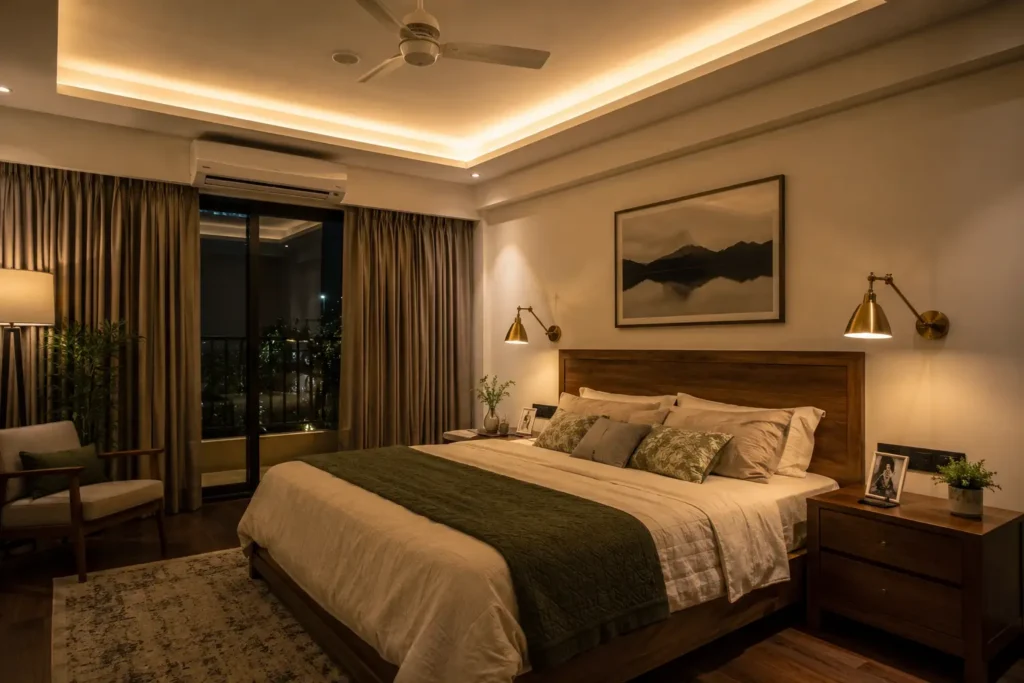
Here’s something we run into almost every month at Blue Interiors. A client walks in with a photo saved on their phone of a gorgeous wall lamp they found online, ready to buy it that day. Then we ask a simple question: where is the wiring point? Silence. Because nobody thought about it until the lamp was already in the cart.
That’s the real problem with wall lamps for bedroom spaces in most Indian homes. The lamp gets chosen first. The wiring gets figured out never, or figured out badly, after the false ceiling is already up and the walls are painted. By then your options have shrunk to surface wiring (which looks exactly as untidy as it sounds) or battery units that need changing every few weeks.
We’re writing this guide because we’ve fixed this problem on-site more times than we’d like to admit. You’ll get a straight answer on where to place wall lamps, how they stack up against hanging lights for bedroom setups, and what needs to happen before your false ceiling stage starts, not after.
This comes from Manish Jain, our Founder and Creative Director, who has been specifying lighting layouts on luxury residential projects across Bangalore for over 15 years. Nothing here is theory. It’s what we’ve learned from redoing other people’s mistakes.
Where Wall Lamps Should Actually Go
Small bedside tables are a very Indian apartment problem. There’s barely room for a phone charger and a glass of water, let alone a table lamp taking up a quarter of the surface. A wall lamp solves this by getting the light off the table entirely and onto the wall, where it belongs.
A wall lamp for a bedroom mounts directly onto the wall next to or above the bed. It throws light down or sideways through a shade, so you get less glare than an open bulb would give you. Mostly it’s there for reading in bed and for a soft glow at night.
In our own projects, we mount these at 100 to 110 cm off the finished floor. That’s roughly shoulder height if you’re sitting upright against the headboard. And here’s the part people skip: this measurement has to be locked in before tiling and wall finishing, not adjusted later.
A note from experience: we mark every wall lamp point on the electrical drawing before the contractor closes conduits into the wall. Once that wall is finished and painted, moving the point means breaking tile or plaster to fix something that should have taken five minutes on paper.

Wall Lamps vs Hanging Lights
Hanging lights for bedroom setups aren’t a straight swap for wall lamps. They solve a different problem, and which one you need depends on your ceiling height more than anything else.
Hanging lights hang from the ceiling on a cord or rod and pool light straight down over one spot. They work well above a bedside table, but only if your ceiling is around 10 feet or taller.
| Factor | Wall Lamps | Hanging Lights |
| Ceiling height needed | Any | 10 ft or more |
| Space taken on nightstand | None | Minimal |
| Where the wiring sits | Wall | Ceiling |
| Adjustable arm | Common | Rare |
| Balance across headboard wall | Simple, both sides | Needs careful spacing |
Most Bangalore apartments sit at 9 to 9.5 feet ceiling height. At that height, we tell clients honestly that pendants tend to look squeezed next to a bed. Wall lamps just sit better in the proportions of the room.
Not sure which one your room can actually take? Rather than guessing from a photo, talk to us before buying anything. Book a free lighting consultation and we’ll tell you plainly what works with your ceiling height.
Planning Around Your Ceiling
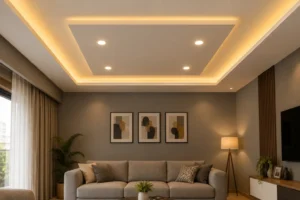
Bedroom lights design isn’t something you can decide in a vacuum, separate from your bedroom ceiling design. If there’s a false ceiling with cove lighting running along the edge, that changes how much wall lighting you actually need.
Bedroom lights design means layering ambient, task, and accent lighting instead of relying on one central fixture. It combines ceiling, wall, and lamp sources at different brightness levels so no single light is doing all the work.
The Houzz India Renovation Trends Study found that homeowners are moving away from single central fixtures toward layered lighting during renovations, and honestly, that tracks with what we’re seeing too. Lighting used to be an afterthought bundled with the furniture budget. Now people ask for it as its own line item.
If your ceiling has cove lighting, keep the wall lamps warm and a bit dim, around 2700K, so they add to that glow instead of arguing with it. No false ceiling at all? Then your wall lamps are basically doing the heavy lifting for ambient light at night, so get a matching pair rather than one mismatched lamp you already owned.
Want to see how this actually looks in a finished room rather than just reading about it? Browse our portfolio of bedroom lighting projects from homes we’ve worked on around Bangalore.

Painted Ceilings Change the Math
Painted ceiling ideas are having a moment in Bangalore bedrooms right now, and they change how light behaves in the room more than people expect.
A painted ceiling is a coloured or textured finish on the false ceiling or the slab itself. Darker colours absorb light instead of bouncing it back, which means the room can feel dimmer than it looks in a photo.
If you’ve gone dark on the ceiling, we usually bump up the wall lamp brightness to around 400 to 500 lumens a fixture instead of adding a third light just to compensate. It’s a simpler fix and it doesn’t clutter the room with extra fixtures.
If you’re pairing a bold ceiling colour with new lighting, our bedroom interior design guide goes into how colour and light need to be decided together, not one after the other.

Choosing by Room Size
A small bedroom and a large master suite don’t need the same lamp.
- Under 120 sq ft: one slim swing-arm lamp per side. Anything bulkier and the room starts to feel tight.
- 120 to 200 sq ft: a matching pair, fixed or adjustable, chosen to go with your headboard finish.
- 200+ sq ft master suites: wall lamps plus one accent light near a reading chair or dresser.
One project that stuck with us: a 3BHK in HSR Layout where we pulled out the builder-grade tube lights and put in brass swing-arm wall lamps on either side of a wooden headboard, with warm cove lighting running around the false ceiling. The couple was specific about one thing: nothing that would clash with the walnut finish on their wardrobe. That’s exactly why we went with brass instead of the chrome they’d originally been looking at.
If you’re setting this up as a shared space, our [bedroom decoration for couples] post covers splitting the lighting control so each side of the bed works on its own. And if warm wood and brass tones like the HSR project appeal to you, our [rustic bedroom style] guide is a good next read.

Before You Install Anything
Before installing bedroom wall lamps, confirm the wiring point exists, use ISI-marked fittings, plan your switch placement, and check what the wall is actually made of. Skip any of these and you’ll find out the hard way, usually mid-installation.
- Confirm the wiring conduit is at the right height before plastering happens, not after.
- Stick to ISI-marked fittings. This lines up with Bureau of Indian Standards guidance on domestic wiring safety, and it’s not a step worth cutting corners on.
- Put individual switches at bedside height. A switch by the door defeats the point of a bedside light.
- Check the wall itself. Partition or drywall sections sometimes need extra anchor support for anything heavier than a basic fixture.

What We’ve Learned Doing This Repeatedly
“Homeowners pick the lamp first and think about wiring later, if at all. We flip that order on every project we take on. A beautiful fixture with no proper wiring behind it isn’t a feature, it’s a compromise you’ll be looking at every night.” — Manish Jain, Founder and Creative Director, Blue Interiors.
The single most common thing we get called back for on completed projects is bedside lighting that was bolted on after handover, because nobody planned it early enough. Once we started treating lighting points as part of the furniture layout instead of a separate decision made three months later, that call-back practically disappeared.
Where This Leaves You
Getting wall lamps for bedroom spaces right isn’t complicated, but it does need to happen in the right order. Mark the wiring before the civil work closes the wall. Match the fixture to your actual ceiling height, not the one in the catalogue photo. And if you’ve gone bold with a painted ceiling or added a bedroom ceiling design with cove lighting, adjust your lamp brightness to match instead of layering on a third light source.
FAQs
What is the best height for wall lamps in a bedroom?
Around 100 to 110 cm off the finished floor, roughly shoulder height if you’re sitting upright in bed.
Are wall lamps better than table lamps for bedrooms?
For small Indian apartment bedrooms, yes, mainly because they free up the nightstand entirely instead of taking up half of it.
Can wall lamps be installed after the false ceiling is done?
You can, but only with surface wiring or a battery-operated unit. Proper conduit wiring needs to go in before plastering.
How many wall lamps do I need for a bedroom?
Two, one on each side, for a double bed. A single bed or a reading corner usually only needs one.
Do wall lamps need a separate switch?
Yes. Put it at bedside height so nobody has to get out of bed to turn their own light off.
Book Your Bedroom Lighting Consultation
Your bedroom lighting should be decided once, not fixed twice. Get it wrong and you’re either living with a lamp that doesn’t fit the room, or paying to break open a wall you just had finished.
Talk to Blue Interiors before you buy a single fixture. We’ll walk through your bedroom’s ceiling height, wiring points, and layout with you, and tell you exactly what will work and what won’t, before your electrician closes anything up.
Book your free bedroom lighting consultation now
About the Author
Manish Jain is the Founder and Creative Director of Blue Interiors, with 15+ years in luxury residential and commercial interiors. He’s overseen lighting and fit-out plans for homes across Bangalore personally, not just signed off on them. View author profile.