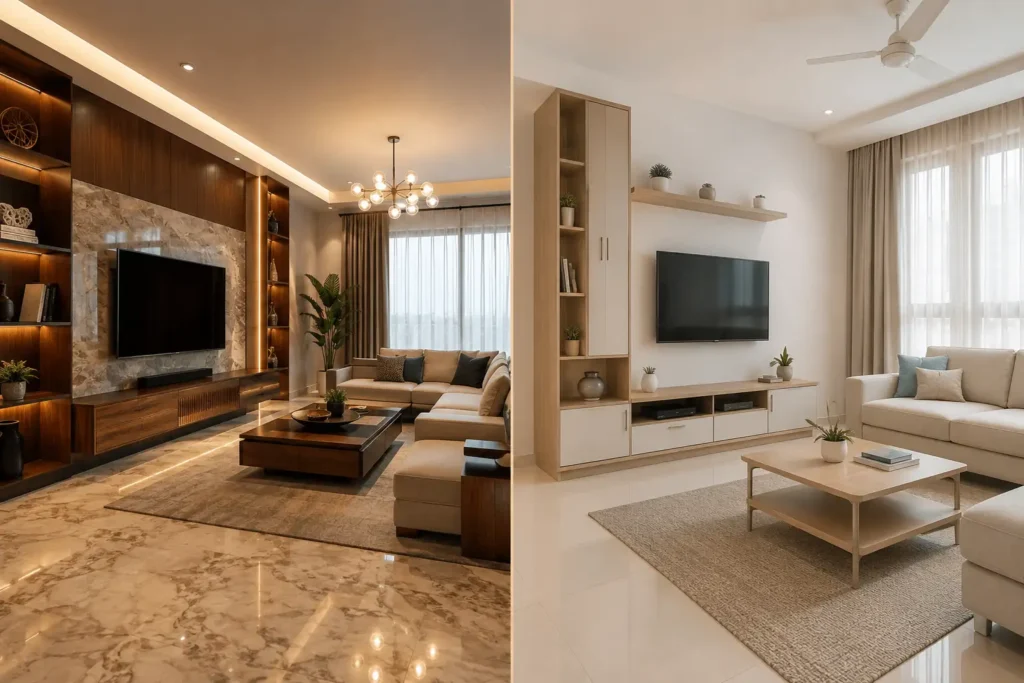
Quick Answer: Go with luxury interior designers in Bangalore if you want bespoke furniture, imported finishes, and someone who owns the project start to finish, and your budget sits above roughly ₹2,500 per sq ft. Go with budget interior designers in Bangalore if modular systems and standard laminates work for you, usually ₹1,200 to ₹1,800 per sq ft. Most homes land somewhere in the middle. Splitting tiers by room is normal, not a compromise.
Key Takeaways:
- Price isn’t what separates the two tiers. Scope, customisation, and who controls the vendors does.
- Affordable interior designers in Bangalore aren’t automatically a downgrade. They just work inside a modular structure.
- A five-question self check tells you your tier before you sit through a single sales pitch.
- Splitting tiers between rooms, luxury where guests look, budget where they don’t, actually works.
Every second person who walks into my studio asking about luxury interior designers in Bangalore doesn’t actually know if they need luxury. They just know they don’t want their flat looking like the one next door. Fair enough. But that’s a different problem, and “book a consultation and find out” isn’t really an answer, it’s a stall tactic dressed up as helpfulness.
I’m not going to sit here and tell you luxury is always worth the extra lakh or two. I’m also not going to pretend budget firms quietly do the same work for less, because they don’t, and anyone who tells you otherwise is trying to close a deal, not help you. What actually decides your tier is boring stuff. How long you’re staying. How much customisation you genuinely care about.
How much control you’re willing to give up. Read this and you’ll know how each tier prices its work, what you get for the money, and whether you’re even talking to the right kind of designer before you waste an afternoon on a pitch that was never meant for someone in your situation.
I’m Manish Jain, I run Blue Interiors. Fifteen-plus years in, and if there’s one thing I’d bet money on, it’s this: the tier mismatch causes more regret than the price tag ever does. I’ve seen it play out too many times to count it as a coincidence anymore.
What Actually Separates Luxury and Budget Interior Design in Bangalore
It’s not talent. Most designers across both tiers trained the same way, thumbed through the same catalogues at some point. What changes is how the work gets sourced. Luxury studios chase down custom veneers, imported stone, one-off hardware made for a single home. Budget and affordable interior designers in Bangalore stick to pre-approved modular systems, mostly because that’s what keeps a project from blowing past its deadline and its budget at the same time.
Luxury interior design in Bangalore is, plainly, a fully customised and execution-heavy service built around bespoke furniture and premium materials. It works because pieces get fabricated specifically for your home instead of pulled off a shelf. It tends to fit villas or bigger apartments where a modular system just runs out of options.
A Houzz India renovation trends study found that Indian homeowners spent a median of ₹3,00,000 on renovations, with kitchens and living rooms topping the list of most-renovated spaces, showing just how much of a typical budget gets absorbed before customisation even enters the picture. I’ve watched that land on people’s faces more than once, usually right around the third line item of a detailed quote.

Is Cheap and Best Interior Design in Bangalore Actually Possible
This is the search everyone actually types, even if they’d never admit it out loud, and the honest answer is partly yes. Cheap and best interior designers in Bangalore can absolutely deliver a good outcome if your scope stays modular and catalogue-driven. What you won’t get, no matter how hard you negotiate, is luxury-level customisation at budget pricing. The hours of skilled labour behind bespoke work just don’t shrink that far. I wish I could tell clients otherwise, but I’d be lying.
“Cheap and best” really means the strongest finish quality you can squeeze out of a fixed, modest budget. It works by cutting custom fabrication out of the equation and leaning on modular components instead. Makes total sense for a rented flat or a first apartment you’re not planning to grow old in.
Here’s something I tell almost every client at this stage, usually while they’re still nodding along to the sales pitch in their head: the ones who end up disappointed are rarely the ones who chose budget. They’re the ones who chose budget pricing while secretly expecting a luxury result. Sort that mismatch out before you sign, not after your kitchen’s half installed and the carpenter’s already gone home for the day. Build your scope off an actual material list, not a folder of villa photos saved from Pinterest at 1 AM.
Where budget projects genuinely cut corners: hinge and channel hardware, and edge banding quality. Both are invisible on the day you get the keys back. Both annoying and expensive to fix two years later when a cabinet door starts sagging on you. What stays roughly the same across every tier is layout, paint, and lighting placement. Civil work costs about the same no matter who’s swinging the hammer, which is exactly where a tight budget can still come out looking sharp if you spend your attention wisely.
Curious where your money should actually go first? Our modular kitchen cost guide for Bangalore homes breaks down exactly where luxury and budget pricing pull apart inside one room.
How Do You Know Which Tier You Need
Sit with these five questions before you take a single meeting, with either tier.
| Question | Leans Luxury | Leans Budget |
| How long will you live here | 10+ years | Under 5 years |
| Is this a villa or independent house | Often yes | Often no |
| Do you want fully bespoke furniture | Yes | Modular works fine |
| Can your timeline flex for fabrication | Yes | No, need fast turnaround |
| Is your budget above ₹2,500 per sq ft | Yes | No |
It really comes down to ownership duration, customisation appetite, and per-sq-ft budget. Homeowners staying ten-plus years in a villa usually belong in luxury. Renters and short-term owners are generally better off in budget or affordable tiers, no matter how much they love a particular wardrobe finish on Instagram.

A client of ours in HSR Layout once walked in wanting the full luxury treatment on a 2BHK she planned to sell within four years. We sat down, ran through this exact table, calculator between us on the desk, and she landed on a hybrid instead. Luxury kitchen and living room, budget bedrooms. The final number came in about 30 percent under what a full-luxury quote would’ve cost her, and honestly, nobody who walked into that living room would’ve guessed which rooms got the “cheaper” treatment.
Not sure which side of that table your home falls on? Get a free, no-pressure quote from Blue Interiors and we’ll be straight with you about which tier actually fits.
What You Get at Each Price Point
This is the bit most comparison articles skip, probably because it’s less fun to write than “which one should you choose.”
Budget tier (₹1,200 to ₹1,800 per sq ft): modular kitchen with laminate shutters, factory-finished wardrobes, standard POP false ceiling, basic electrical and lighting layout, one or two design revisions before extra charges kick in.
Mid tier (₹1,800 to ₹2,500 per sq ft): upgraded shutter finishes like acrylic or PU, better hardware brands, some customisation on TV units and wardrobes, more design revisions, and a project manager who actually answers your calls.
Luxury tier (₹2,500 to ₹5,000+ per sq ft): fully bespoke furniture, imported stone or veneer, designer lighting layouts, smart home integration if you want it, reasonable unlimited revisions, and full ownership of the project from first sketch to final handover.
A 2BHK in Bangalore usually runs ₹4 to ₹8 lakhs at budget tier and can cross ₹15 lakhs at luxury tier, depending on how much customisation creeps in along the way, and it does creep in, almost every time. Villas scale up further still, often past ₹20 lakhs once imported stone and bespoke joinery enter the conversation.

For a wider breakdown of what actually shapes these numbers before you commit to anyone, our buyer’s guide to hiring interior designers in Bangalore goes deeper than just the headline per-sq-ft figure.
Can You Mix Luxury and Budget Design in the Same Home
Yes, and honestly it’s one of the smartest moves I see clients make, and one of the most underused. Guests see your living room and kitchen. Nobody, ever, inspects the hinges on your spare bedroom’s wardrobe.
Mixed-tier design puts the luxury spend where people actually look and lets budget-tier execution handle the private, secondary rooms. It works because it matches money to visibility instead of applying one blanket standard across a home that doesn’t need it everywhere. Comes up all the time in 3BHK and villa projects where the total budget just won’t stretch to full luxury.

If you’d rather see this than imagine it, our portfolio of completed Bangalore projects shows what a mixed budget actually looks like once it’s built, not just typed out on a quote sheet.
What to Ask Before You Sign With Anyone
Whichever tier you land on, ask for a material-wise breakdown, not a single lump sum number. If a firm won’t itemise plywood grade, hardware brand, and finish type, that’s a red flag regardless of price point, luxury included, no exceptions.
Ask about warranty on woodwork and hardware. Ask what a realistic timeline looks like from design sign-off to handover. Ask how many revisions are actually included before you start paying extra. These three questions alone would’ve saved a good number of my past clients some very awkward phone calls midway through their projects.
Look closely at reviews too. A firm with genuinely finished projects usually has a real, visible portfolio and won’t flinch at connecting you with a past client. Our guide on what to look for in an interior design company in Bangalore lists the specific red flags worth checking before you hand over a booking amount you can’t get back.
Want a side-by-side on how firms across tiers actually handle process and delivery? Our honest 2026 guide to comparing interior designers in Bangalore is worth ten minutes before you shortlist anyone.
And if price isn’t the only thing you’re weighing, our piece on how to choose home interior designers in Bangalore covers the other factors that matter just as much once quotes start landing in your inbox.
What I’ve Learned After 15 Years of Both Ends of This
“The tier question is not a status question. It’s a duration and use-case question. I’ve had clients spend luxury money on a home they sold in three years, and I’ve seen clients get twenty years out of a smart budget build. The math only works when you’re honest with yourself about how long you’re staying.” That’s a line I find myself repeating in nearly every consultation, and it hasn’t stopped being true yet.
Fifteen-plus years into this, across luxury villas and tight-budget rentals alike, one pattern hasn’t budged. Clients regret a mismatched tier far more than they ever regret the price they paid inside the right one.
Where That Leaves You
Luxury and budget interior design in Bangalore aren’t rivals. They’re different tools for different situations, and neither is automatically the smarter choice, whatever the ads tell you. Run the five-question check above before you meet a single designer. Whether you end up with luxury interior designers in Bangalore, best affordable interior designers in Bangalore, or something split down the middle, insist on a material-wise quote before you sign a single page.
Frequently Asked Questions
How do I know if I’m overpaying an interior designer in Bangalore?
Ask for a material-wise breakdown, not a lump sum figure. If plywood grade, hardware brand, and finish type aren’t itemised separately, you can’t fairly compare one quote against another, and that’s usually where overpaying slips past unnoticed.
Do luxury interior designers in Bangalore offer any warranty?
Most reputable luxury firms cover woodwork and hardware under warranty, typically one to several years depending on the firm. Get it in writing before signing, since verbal promises made during a consultation rarely hold up once the project is actually underway.
How long does a luxury interior design project take compared to a budget one?
Luxury projects usually take longer because of custom fabrication, often 60 to 120 days depending on scope. Budget, modular-driven projects move faster, generally 30 to 60 days, since parts come from pre-approved catalogues rather than one-off production.
Should I hire separate designers for different rooms to save money?
It’s possible, but it usually creates coordination headaches, mismatched finishes, and nobody clearly accountable if something goes wrong later. One firm handling a mixed-tier approach keeps the design language consistent while still controlling cost room by room.
What happens if my budget runs out midway through the project?
A well-structured quote flags high-risk cost areas upfront, like custom furniture or imported materials, so you’re not blindsided later on. If your budget does tighten mid-project, talk to your designer about shifting the remaining rooms to modular instead of pausing everything.
Ready to Build the Right Home for Your Budget, Not Someone Else’s Sales Target
Stop guessing which tier fits and get a straight answer from someone who actually works in both. Book your free consultation with Blue Interiors and walk out with a real, itemised quote, whatever your budget looks like. You can also look through our full range of interior design services to see exactly what’s included at each level before anyone tries to sell you anything.
Author
Manish Jain is the Founder and Creative Director of Blue Interiors, with 15+ years of excellence in luxury residential and commercial interiors across Bangalore. Author profile page coming soon.