
Quick Answer: The right home interior designers in Bangalore specialise in homes, not offices, and they’ll show you a written scope, a fixed timeline, and a material list before you pay a rupee. Check their portfolio for homes your size and budget, ask for two client references you can actually call, and make sure the payment schedule is tied to milestones, not a big chunk upfront. If a firm goes vague when you ask about material brands or warranty terms in the first meeting, that tells you everything you need to know.
Key Takeaways:
- Home interior designers in Bangalore and commercial firms are not the same thing, no matter what the website says. Residential specialists understand daily-use furniture, family routines, and Vastu preferences that commercial designers rarely deal with.
- Judge a portfolio by homes in your budget and BHK size, not the flagship villa on the homepage.
- A milestone-based payment structure is the single biggest thing standing between you and a stalled project.
- Warranty terms, material brands, handover timeline. Get it in writing. All of it.
- Bangalore’s climate, apartment layouts, and local material sourcing actually change design outcomes. Local expertise isn’t just a marketing line.
About 340 people a month search for home interior designers in Bangalore, and from what we see, most of them are already comparing three or four firms before they pick up the phone. Fair enough. This is exactly the kind of decision where a wrong guess costs you months, not minutes.
Here’s the thing nobody tells you upfront: if you’ve spent an evening flipping through interior design websites, you’ll notice they all sound the same. Fifteen years of experience. Premium quality. On-time delivery. Every firm says it. None of it tells you who actually shows up at your site, who manages your carpenter when he’s running late, or why your kitchen shutter started warping in month four.
That’s the real problem with comparing home interior design bangalore firms. They look identical on the surface. The differences only show up once you’re inside the contract, the material sheet, and the way a designer talks about your specific flat instead of reciting a showroom script.
So this guide sticks to what actually matters: how to shortlist home interiors bangalore firms by whether they genuinely specialise in homes, what questions expose real quality versus a good sales pitch, and how to read a quote without getting talked into signing on the spot.
Manish Jain is the Founder and Creative Director of Blue Interiors, with 15+ years of experience in luxury residential and commercial interiors across Bangalore.
Why Home-Focused Designers Differ From Commercial Firms
We get this a lot: a homeowner shortlists a firm because they’ve done a couple of flashy offices, assuming bigger projects mean better designers. It doesn’t work like that. A commercial fit-out is built around speed, standardised furniture, and compliance codes for public spaces. Your home is built around one family’s actual life, and that’s a different job entirely.
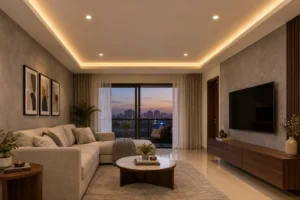
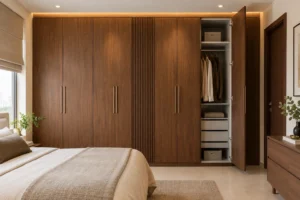
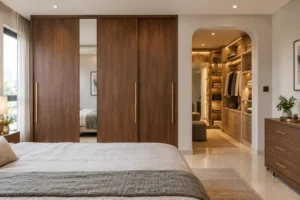
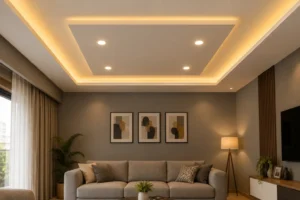
Home interior decorators in Bangalore who genuinely specialise in residential work care about livability and daily-use durability, not corporate branding. They ask how each person in the house actually uses a room before they design storage or lighting around it. You’ll see this play out most clearly in full-home turnkey projects, modular kitchens, and bedroom-wardrobe combinations.
Homeowner tip: just ask the firm what share of their last 20 projects were homes versus offices. If it’s mostly commercial, your home will end up looking like a smaller office. It always does.
What Residential Specialisation Looks Like in Practice
- Material choices built for a wardrobe that gets opened forty times a day. BWP-grade plywood and branded hardware, not office-grade laminate.
- Layouts that account for a toddler, an ageing parent, or someone working from the dining table every day, not a generic floor plate.
- Real accommodation of Vastu preferences for pooja rooms, kitchen placement, main door direction. Most commercial firms have never had to think about this once.

Still not sure if the firm you’re talking to actually specialises in homes? Talk to a residential design specialist at Blue Interiors and just ask them directly. A good firm won’t dodge the question.
How to Verify a Designer’s Portfolio Properly
A pretty gallery on a website tells you almost nothing. Portfolios show the best six projects out of however many hundred they’ve actually done. You have to look past the photography to figure out anything useful.
A real portfolio check means matching showcased projects to your BHK size and budget, then asking to see one project end to end, from the first site visit to the actual handover photos, not the polished render. Cross-check the numbers they quote you against Google reviews and Instagram tags while you’re at it. It’s a decent way to weed out firms that quietly hand off execution to a subcontractor you’ll never meet.
According to the Houzz India Renovation Trends Study, homeowners who checked at least three comparable past projects before hiring reported noticeably higher satisfaction with the result than those who decided after one showroom visit. Makes sense when you think about it.
Questions to Ask While Reviewing a Portfolio
- Can you show me a 2 BHK or 3 BHK project close to my budget, not just your flagship villa?
- Who actually executed this project, your in-house team or a subcontractor?
- Do you have before-and-after site photos, not just final renders?

You can also check a designer’s registration on the Council of Architecture website before your first meeting. It takes five minutes, and you walk in already knowing who you’re dealing with.
What a Fair Pricing Structure Looks Like
Pricing confusion is probably the number one reason homeowners feel cheated later. Two firms can quote very different numbers for what sounds like the same job, because “full home interior” means something different depending on who’s saying it.
Fair pricing for interior design for home bangalore looks like a per-square-foot or per-room rate that spells out exactly what’s included: carcass material, hardware brand, shutter finish, number of design revisions. Break the total into carpentry, execution, and design fee. Don’t accept one bundled number and hope for the best. This matters most when you’ve got two or three quotes sitting side by side and you’re trying to figure out why one is double the other.
| Home Size | Typical Budget Range (Bangalore, 2026) | What’s Usually Included |
| 1 BHK | Rs 4 to 7 lakh | Kitchen, wardrobes, basic living room |
| 2 BHK | Rs 8 to 14 lakh | Full carpentry, false ceiling, modular kitchen |
| 3 BHK | Rs 14 to 24 lakh | Full turnkey, premium finishes, custom furniture |
| 4 BHK or Villa | Rs 25 lakh and above | Complete luxury turnkey, in-house production |
Expert tip: always check whether the quoted rate is carpentry only or full turnkey. Same per-square-foot number, two very different jobs. This trips people up more than anything else.

Want a real, line-itemised quote instead of a number pulled out of thin air? Get your free home interior quote from Blue Interiors.
What Questions to Ask Before Signing a Contract
Almost every dispute we hear about, between a homeowner and their designer, traces back to something that was said out loud but never written down. A short list of direct questions at the consultation stage fixes most of this before it becomes a problem.
Cover the timeline, the payment milestones, the warranty, and what happens if you change your mind about a material halfway through. Ask before you pay the advance, not after. It forces the designer to give you specifics instead of a reassuring nod.
Questions That Reveal How a Firm Actually Operates
- What is the payment schedule, and is it tied to milestones or one fixed upfront amount?
- If I want to swap a material mid-project, is there an actual change-order process, or does it just get argued about later?
- What’s the realistic timeline for my home, and what happens if that date slips?

Real Case Study: A 3 BHK in HSR Layout
A family in HSR Layout came to us after their previous designer’s quote grew by nearly 30 percent once carpentry actually started, because the original number never specified plywood grade or hardware brand. Classic case of “premium plywood” meaning whatever the vendor felt like on delivery day. Manish Jain’s team re-scoped it with a proper line-itemised quote, BWP plywood, Hafele hardware, and a fixed 45-working-day timeline tied to payment milestones. The handover happened on schedule. What the family actually said afterward wasn’t about how the space looked. It was that they finally knew what they were paying for at every single stage.
Expert tip: get material brand names written down, not vague phrases like “premium plywood” or “branded hardware.” That vagueness is exactly where costs quietly creep up.

Trust and Authority
“The homeowners who end up happiest aren’t the ones who chose the cheapest quote. They’re the ones who asked the most specific questions before signing anything.” Manish Jain, Founder and Creative Director, Blue Interiors, 2026.
Here’s something we’ve noticed over the years that you won’t find in any report: the biggest predictor of a smooth project isn’t budget size at all. It’s whether the homeowner asks about the payment milestone structure in the very first meeting. The families who ask that question upfront almost never end up in a dispute later, because both sides are forced to agree on what’s owed and when, before a single wall gets touched.
Conclusion
Choosing between home interior designers in bangalore really comes down to three things. Check whether they actually specialise in homes. Read the pricing structure line by line. Get timelines and warranty terms in writing, not promised over chai in a showroom. A firm that answers direct questions about materials and payment milestones without flinching is almost always the safer bet over one that stays vague. Compare two or three shortlisted firms before you commit. It’s still the best predictor of how smoothly your project goes.
FAQs
Is it better to hire an independent interior designer or a design firm in Bangalore?
An established firm usually gives you more accountability, since there’s a company behind the warranty, not just one person you’re trusting. Independent designers work fine for smaller, single-room jobs, but for full-home turnkey work, a firm with in-house production and a dedicated project manager just carries less risk.
How long does a full home interior project take in Bangalore?
A full 2 or 3 BHK turnkey project usually takes 45 to 90 working days from design approval to handover, depending on material availability and how fast you approve each stage. Get this timeline in writing before you sign anything.
Do home interior designers in Bangalore offer a warranty?
Most established firms offer somewhere between 1 and 10 years, usually covering hardware and carpentry defects. Confirm exactly what’s covered and get it in writing. Verbal promises don’t hold up when something actually breaks.
Can I hire a home interior designer in Bangalore for just one room?
Yes, plenty of firms, Blue Interiors included, take on single-room work like a modular kitchen or a master bedroom, not just full-home contracts. Some firms only do full-home projects though, so confirm this before you get too far into a conversation.
What is the difference between a design fee and an execution fee?
The design fee covers concept, layout, and 3D visualisation. The execution fee covers the actual carpentry, material procurement, and site work. Some firms bundle both into one number, which makes comparing quotes harder than it needs to be. Ask them to split it out.
Stop Comparing Websites. Start Talking to Someone Who’ll Actually Build It.
You’ve read the checklist. You know what to ask now, and you know exactly what a vague answer sounds like. The next step is simple: sit down with someone who’ll put your budget, your timeline, and your material list in writing before you spend a single rupee.
Book your free home interior consultation with Blue Interiors →
No pressure, no lump-sum advance, just a straight answer to every question on this page.
Author Bio
Manish Jain is the Founder and Creative Director of Blue Interiors, with 15+ years of experience in luxury residential and commercial interiors across Bangalore. He has personally overseen full-home turnkey projects across HSR Layout, Whitefield, and Sarjapur Road.