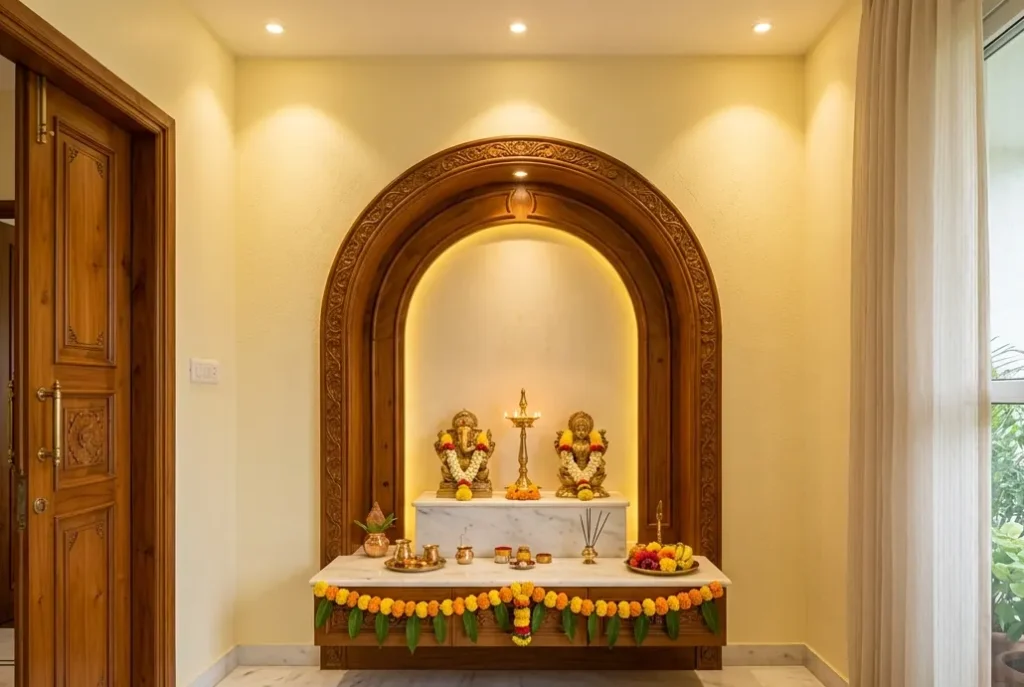
The short answer: Place your pooja room in the Northeast (Ishan) corner of your home. Idols face East or West. Flooring in white marble or natural stone. Ground floor only, away from bathrooms and kitchens. That decision, made before construction, separates a prayer space that genuinely works from one that looks right but never feels right.
Why Pooja Room Vastu Matters More Than Any Other Room
Most homeowners treat the pooja room as the last thing to figure out. The kitchen layout gets three rounds of revision. The master bedroom gets the best corner and the most deliberate lighting. The mandir gets whatever space is left over after everything else is planned.
That is the mistake that is hardest to undo.
You can repaint a bedroom after you move in. You can swap kitchen tiles in a weekend. But if your pooja room lands in the wrong direction, correcting it means breaking walls, re-doing flooring, and reworking electrical. In a Bangalore apartment where every square foot already cost you a significant amount, that is not a small correction.
According to a 2024 survey by Housing.com, over 68% of Indian homeowners say Vastu compliance directly influences their final layout decisions. The pooja room consistently ranks above the master bedroom and kitchen as the space they are most anxious to get right. That anxiety is well-placed.
In pooja room vastu shastra, the prayer room is where cosmic energy enters and concentrates in the home. Everything else in the house draws from it. Direction, materials, idol placement, and lighting are not decorative choices here. They are structural ones. And structural choices need to be made before the first wall goes up, not after.

What Is the Best Direction for a Pooja Room as Per Vastu Shastra?
Which direction is best for the pooja room according to Vastu?
Northeast, called Ishan Kon in Vastu texts, is the only first-choice answer. Not a close second. Not one of several good options. The Northeast corner is governed by Lord Shiva, receives the earliest rays of the morning sun, and is described in Vastu tradition as the zone where divine energy concentrates most naturally in any built structure. Every other direction is either a fallback or a prohibition.
| Direction | Vastu Suitability | Reason |
| Northeast (Ishan) | Best | Zone of Lord Shiva, divine cosmic energy |
| East | Excellent | Rising sun, new beginnings, career growth |
| North | Good | Governed by Kuber, calm and prosperity |
| West | Acceptable | Requires Vastu remedies such as copper pyramids |
| South | Avoid | Associated with Yama, fire energy and conflict |
| Southwest | Avoid | Ancestral zone, unsuitable for daily worship |
In fifteen years of designing interiors across Bangalore, the Blue Interiors team has seen the same pattern repeat in almost every builder floor plan. The Northeast corner gets assigned to a utility room, a dry balcony, or a broom cupboard. Builders are optimising for saleable square footage. They are not thinking about the spiritual architecture of the home.
The homeowner who reclaims that corner for the pooja room at the layout stage, before civil work begins, is making the single highest-value spatial decision available to them. It costs nothing to change a drawing. It costs a great deal to change a wall.
Read our complete guide on Vastu direction for every room in your Bangalore home to understand how the pooja room anchors the energy of your entire floor plan.

Which Directions Should You Avoid for Your Pooja Room?
Can a pooja room be placed in the South or under a staircase?
No. And the reasons are specific, not vague.
The South is Yama’s direction and carries fire energy in Vastu. Families with a vastu puja room design placed in the South frequently report that the prayer space slowly stops being used, without anyone consciously deciding to stop. The room starts to feel uncomfortable in a way nobody can articulate. That is the most common symptom of a directionally wrong mandir.
The Southwest is the ancestral zone. Placing active daily worship here creates a frequency conflict that Vastu texts describe in detail. The energy of honouring the departed and the energy of connecting with the divine are categorically different. They do not belong in the same directional zone.
Under a staircase places the divine beneath the structural weight of the house. This is considered inauspicious across every Vastu tradition without exception, and the symbolism explains itself.
Sharing a wall with a bathroom is the most common error in Bangalore apartments, and the most consistently overlooked. Builders routinely place the mandir adjacent to a wet area because it works for plumbing routing. It does not work for Vastu. Even one shared wall between the prayer room and a bathroom constitutes a Vastu dosh that undermines the sanctity of the space regardless of how well it is designed.
Basement or top floor placement is also ruled out. Vastu specifies the ground floor. In a multi-storey apartment, this means the base level of your unit, not the building’s ground floor.
Idol Placement Rules: Height, Spacing and Facing Direction
Which way should the idols face in the pooja room?
Idols face East or West only. North or South facing positions are not correct. When idols face West, the worshipper naturally faces East toward the morning sun during prayer. When idols face East, the worshipper faces West. Both orientations are accepted in Vastu and the choice depends on your room layout.
Idol height is something most homeowners have genuinely never thought about. The rule is unambiguous. Between 2 inches and 9 inches only. Larger murtis are designed for temples, where the scale of the space and the nature of the worship are both different. At home, an oversized idol shifts the atmosphere of the mandir from devotion toward display. That shift is subtle and consistent.
Position the platform so the idol’s feet sit at the chest level of the seated worshipper. Leave 1 to 1.5 inches of space between the idol and the wall behind it. Idols must never lean against a wall, regardless of how secure it appears.
When keeping multiple deities, place all of them at the same level. Stacking one above another is not appropriate. Remove broken or chipped idols immediately. Photographs of deceased relatives do not belong in the mandir. Images depicting war, grief, or suffering do not belong anywhere in the prayer space.

Design Your Pooja Room Before the Walls Go Up
By the time most homeowners start thinking about the mandir, the civil work is already locked. Blue Interiors works with you at the floor plan stage, before construction begins, so the direction is correct from day one. Book a free consultation with Blue Interiors today.
Pooja Room Vastu for Apartments and Flats in Bangalore
How do you follow vastu for pooja room in a flat when space is genuinely limited?
This is the question the Blue Interiors team fields more than any other from Bangalore clients. Most are working with 2BHK apartments under 1,000 sq ft where a dedicated prayer room was never part of the builder’s floor plan.
A recessed wooden mandir unit built into the Northeast wall of your living or dining area satisfies pooja room vastu direction in apartment guidelines fully. A 3 ft x 4 ft niche is enough. Direction always takes priority over size. A small correctly placed mandir consistently outperforms a large incorrectly placed one. There is no exception to that in our experience.
Before finalising any position, check what sits on the floor directly above your unit. If the apartment above has a toilet or wet area overhead your intended mandir position, move the niche. The overhead rule is as important as the directional one, and it gets missed far more often.
Never share a wall with a bathroom. Keep the mandir completely separate from the kitchen. Cooking fire energy and sattvic worship energy do not belong together. Vastu separates them for reasons that are both energetic and practical.
Case Study, Whitefield Bangalore: A family in a Prestige 3BHK came to Blue Interiors with a builder floor plan that placed the kitchen in the Northeast and the pooja room sharing a wall with the master bathroom. Both positions were wrong. The Blue Interiors team redesigned the layout before any civil work started. The mandir moved to the Northeast corner of the living area.
The final unit was a 4 ft x 3 ft recessed teak wood mandir with warm spotlighting, white marble shelving, and a double-shutter door. Weeks after moving in, the family told the team that their morning prayer routine, which had stopped entirely in their previous home, returned without any deliberate effort on their part. They did not decide to start again. It just happened. That is what directionally correct placement does to a family’s relationship with their sacred space. It removes the friction that was never supposed to be there.
Our home interior design services include Vastu-compliant mandir design as part of every turnkey project. It is the first conversation, not the last.

Flooring and Materials as Per Vastu
What flooring is best for a pooja room as per Vastu?
White or cream marble is the right answer for vastu shastra puja room flooring. It stays cool underfoot, reflects natural light back into the space, and is the material Vastu texts most consistently associate with sattvic energy. Light-toned wood is a credible second option. White, cream, or pale yellow ceramic or vitrified tiles work for apartments where marble is not in budget.
Dark granite, black stone, acrylic, and glass finishes are not suitable anywhere in the prayer room. The idol platform must be wood or marble. Acrylic and plastic platforms are widely sold and consistently wrong. Do not use them regardless of how they look.
A pyramid-shaped or gently sloped ceiling directs spiritual energy upward rather than letting it disperse laterally. Where the ceiling height and budget allow, this detail is worth building in.
Lighting Vastu for Pooja Room
The diya or lamp stand belongs in the Southeast corner of the room. This is the Agni zone in Vastu and the structurally correct home for any fire element. Use warm, soft lighting throughout. Cool-white LED strips are consistently wrong for a prayer space. They look clean in photographs and feel sterile in practice. A space lit with harsh white light loses its meditative quality quickly and most families cannot explain why they stop wanting to spend time there.
Plan for a small East-facing window or ventilation opening if the layout permits. Morning light from the East is genuinely beneficial and worth prioritising. No mirrors belong inside the pooja room. Vastu is specific about this. Mirrors scatter and distort energy in sacred spaces.
Recessed warm spotlights above the idol shelf are a detail the Blue Interiors team uses across almost every mandir project. The glow feels intentional rather than theatrical, and it sits fully within Vastu guidelines.

Colours for Pooja Room as Per Vastu
Which colour is good for a pooja room as per Vastu Shastra?
White is the most reliable choice for a Northeast-placed room. It works with both natural and artificial light without distorting the mood and ages well over years of daily use. Pale yellow or cream sustains focus during prayer. Light blue is calming in a way that supports extended meditation rather than interrupting it. Soft green brings balance. Pastel orange works only as an accent on a single surface, not as a wall colour.
Black, dark grey, and dark brown actively suppress the sattvic atmosphere that a vastu puja room design needs to generate every morning for years. Bold patterns do the same. They are not neutral background choices. In a prayer space, they are disruptive ones.
Door and Entrance Design for Pooja Room
What type of door should a pooja room have as per Vastu?
Double-shutter wooden doors are the correct choice. Single-door designs are considered less auspicious for sacred spaces in Vastu tradition. A wooden threshold at the entrance is both traditional and practically sound. It marks a clear physical transition from the everyday parts of the home into the sacred space. That boundary matters.
Position the door on the North or East wall wherever the layout allows. Never place idols directly opposite the entrance door. A diagonal position is always the better choice. The door must open inward.
How Blue Interiors Designs Vastu-Compliant Pooja Rooms in Bangalore
Blue Interiors has designed and delivered pooja rooms across 5,000 homes in Bangalore over fifteen years, from 1BHK flats in Electronic City to 4BHK villas in Devanahalli. The clearest lesson from that volume of work is this. A vastu puja room design that follows Vastu principles does not have to look traditional, feel dated, or compromise on modern aesthetics. When the planning is done correctly at the start, tradition and contemporary design work together without any tension.
Every Blue Interiors project begins with a directional audit of the floor plan before any design proposal is made. The Northeast corner is identified and protected first. Everything else follows from that. Material selection, dimensions, lighting placement, idol platform height, door position. Nothing gets retrofitted. Every decision is made at the stage where it is still free to make.
Expert Tip from the Blue Interiors Design Lead: “We have asked clients to go back to their architects and revise floor plans before we would begin any design work, specifically because the pooja room position was wrong. Some clients are surprised we push that hard. But a mandir in the right direction that a family actually uses every morning is worth more than an expensive beautifully finished mandir in the wrong corner that the family quietly stops visiting. We have seen both outcomes enough times to know the difference.”
Explore our mandir and pooja room design portfolio or read our guide on how we approach turnkey interior design for Bangalore homes to understand how this process works across a full project.

Vastu Checklist: Pooja Room Before You Build
- Room or niche placed in Northeast, East, or North direction
- Not adjacent to or sharing a wall with any bathroom
- Not positioned in the basement or under a staircase
- Idol height between 2 and 9 inches
- Idol facing East or West
- Diya or lamp positioned in the Southeast corner
- White, cream, or marble flooring
- Light wall colours in white, cream, or pale yellow
- Double-shutter wooden door with a threshold
- No mirrors anywhere inside the prayer space
- No photographs of deceased family members in the mandir
FAQs: Pooja Room Vastu Shastra
Which direction should the pooja room face in a home?
Northeast (Ishan Kon) is the most auspicious direction for pooja room vastu shastra placement. If Northeast is unavailable, East or North are the acceptable fallbacks. South and Southwest should not be used.
Can we keep a pooja room in the bedroom as per Vastu?
Strongly discouraged. A bedroom’s energy profile is incompatible with a sacred prayer space. If there is genuinely no alternative, close the mandir with a curtain at night and ensure it never faces the bed directly.
What should not be kept in a pooja room as per Vastu Shastra?
Broken idols, photographs of deceased relatives, images depicting war or grief, dark fabrics, mirrors, and electronic appliances must all be removed. Nothing should be placed on any shelf above the idol.
How do I apply vastu shastra for pooja room design in a small home?
A recessed niche of minimum 3 ft x 4 ft in the Northeast corner is fully sufficient for vastu for pooja room in flat or compact homes. Wooden mandir unit, white marble shelving, warm LED lighting, double-door design. Direction takes priority over size every time.
What is the correct height for a pooja room platform?
The platform should be positioned so the idol’s feet sit at the chest level of the seated worshipper. Wood or marble platform raised off the floor. Floor-level idol placement is not recommended.
Conclusion
Pooja room vastu shastra has fifteen hundred years of refinement behind it. The direction, materials, lighting, and idol placement work as a single integrated system. Adjust one element without considering the others and the whole thing loses its coherence. The room looks right. It does not feel right. And over time, families stop using it.
In a Bangalore apartment or villa where every square foot carries real financial weight, getting this right before construction begins costs nothing extra. Getting it wrong costs you a wall, a renovation, and years of a prayer space that quietly underperforms.
If you are at the layout or design stage right now, this is the only conversation that matters before anything else gets finalised.
Design Your Pooja Room Right: Consult Blue Interiors Before Construction Begins
Most Bangalore homeowners find out about Vastu errors after the tiles are down and the walls are up. Blue Interiors works with you at the floor plan stage, before a single wall is built, to position, design, and execute a vastu-compliant pooja room built to last for decades without ever needing to be corrected.
5,000 homes delivered. 10-year workmanship warranty. Full turnkey execution across Bangalore.
Book Your Free Pooja Room Consultation with Blue Interiors
Author Bio
Written by the Design Team at Blue Interiors. Blue Interiors is a premium interior design studio in Bangalore with 15 years of experience, 5,000 homes delivered, and a 4.9 Google rating. Their team of Vastu-aware interior designers specialises in turnkey home interiors, including sacred spaces designed to honour both tradition and modern craft.